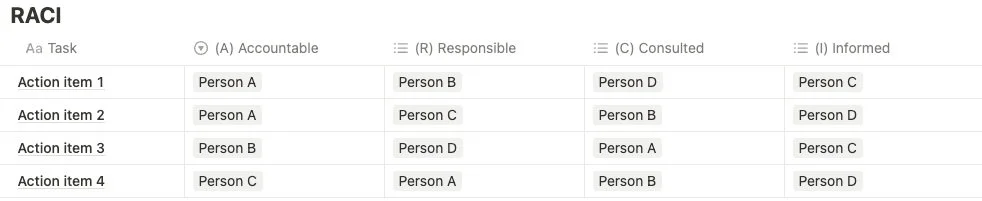
Accountability Matrix
One of the most common conflicts that happen on any team, especially early-stage startups, stems from the lack of clarity of who is doing what and what role each person is playing on a team. Taking a few minutes to designate roles and responsibilities using the RACI format before diving into executing and sprinting can help you avoid many of these conflicts and provide clarity to each team member. You can use whatever code works for your team so long as you know what the different categories mean. You could use colors or numbers but the traditional way to use RACI is as follows:
(A) Accountable: The buck stops with this person. They are the most accountable person on the team and the final decision-maker. If this project fails, this person’s neck is on the line. There should only be one accountable person for each task or area of work to keep things crystal clear.
(R) Responsible: The responsible person has a lot of skin in the game. They are deeply involved in the work but they aren’t the ultimate decision maker. These are folks who would look pretty bad if there was a failure, but ultimately it’s the accountable person who has to take the blame for the team’s execution. There can be multiple responsible people on a task or project.
(C) Consulted: Folks who play the “consulted” role need to be asked for their opinions. They are advice-givers. It doesn’t necessarily mean the team has to follow their advice, but they have to ask and listen.
(I) Informed: These are people who need to be kept in the loop. They may be people to manage up or down, but there’s some reason they need to know what’s going on. Perhaps this work impacts their portfolio of projects. Or, perhaps this person may have the ability to solve a red flag problem if one emerges. Think about the whole range of the organization and who would benefit from being kept in the know.
You may want to explore having a big-picture RACI chart for who does what in the organization, generally. We find it’s also particularly helpful to do a RACI with goals (OKRs) and with complicated time-bound projects for which tight coordination in advance will ensure that everything goes smoothly.
Having an accountability matrix proactively helps people play the right role - it also makes it easier to have uncomfortable conversations when someone crosses over a lane. Instead of it being heavy or heated, you can simply refer back to the RACI chart to remind someone that they’re a “C” on this particular task - not an “R.