I launched Founder to Leader in January of 2022, which makes this coming January my five year anniversary. The only other place I’ve worked at for this long is MIT, which was also five years. The rest of my career has been a lot of 1-2 year sprints at a myriad of organizations including start-ups, non-profits, academia, for-profits, and venture capital. At some point along the journey I realized that I’m addicted to steep learning curves. I crave solving complex problems. I found that I could get my fix by moving to new organizations as soon as the problems didn’t seem hairy enough anymore. That approach was effective, however, it was extremely exhausting. I found the transition periods to be particularly trying because it wasn’t obvious what my next step would be with my unconventional background.
At some point in my earlier forties I realized that a different model might satiate my appetite for novel challenges: I could stay put and new problems could come to me. It was one of the driving factors that gave me the idea to launch Founder to Leader. I love working with founders and technologists and I was yearning for the right balance of intellectual freedom and high impact. I was essentially a single mom well before my divorce in 2023, and I needed more control over my schedule so I could be present for my son. And when my last boss made my life too difficult, it was just the right kick in the pants at just the right time to give me the chutzpah to give it a shot to go out on my own as Founder to Leader.
At first I felt like the greatest poser of all times calling myself a coach. They say “fake it until you feel it” and that’s exactly what I did. It wasn’t until I helped enough clients navigate enough hard things that I started to feel confident introducing myself as an executive coach. Now, five years later, I don’t just feel that being a coach is my professional title, it’s who I am. I found the perfect role for me.
I’ve been doing a lot of reflecting on why I love this work and what keeps me so engaged five years later. I love helping other people. I love building one-on-one relationships with clients and understanding what makes them tick. I love helping new start-ups get set up with healthy systems. I love teaching and mentoring. I love challenging myself and continually learning. I love seeing others shine. I love that all of my clients are making the world a better place with their human health and climate innovations. Every day I feel so fortunate to be working with such talented and visionary people.
One of the things that’s really interesting about being a coach is that, if I’m successful, my work is primarily invisible. I’m bound to confidentiality so I can’t disclose much about what I’m working on at any given moment to anyone. The good news is: I’m not motivated by fame or recognition so that works out just fine for me. But as my fifth year of coaching is upon us, I find myself wanting to share some of the stories of my proudest moments as a coach. And yet, every time I start writing this list, I feel uncomfortably braggy and then hide it. I decided to make that list and label it “In Case of Emergency,” inspired by my recent read Resilient Optimism; I’ve tucked that list away for a rainy day when I need a pick-me-up.
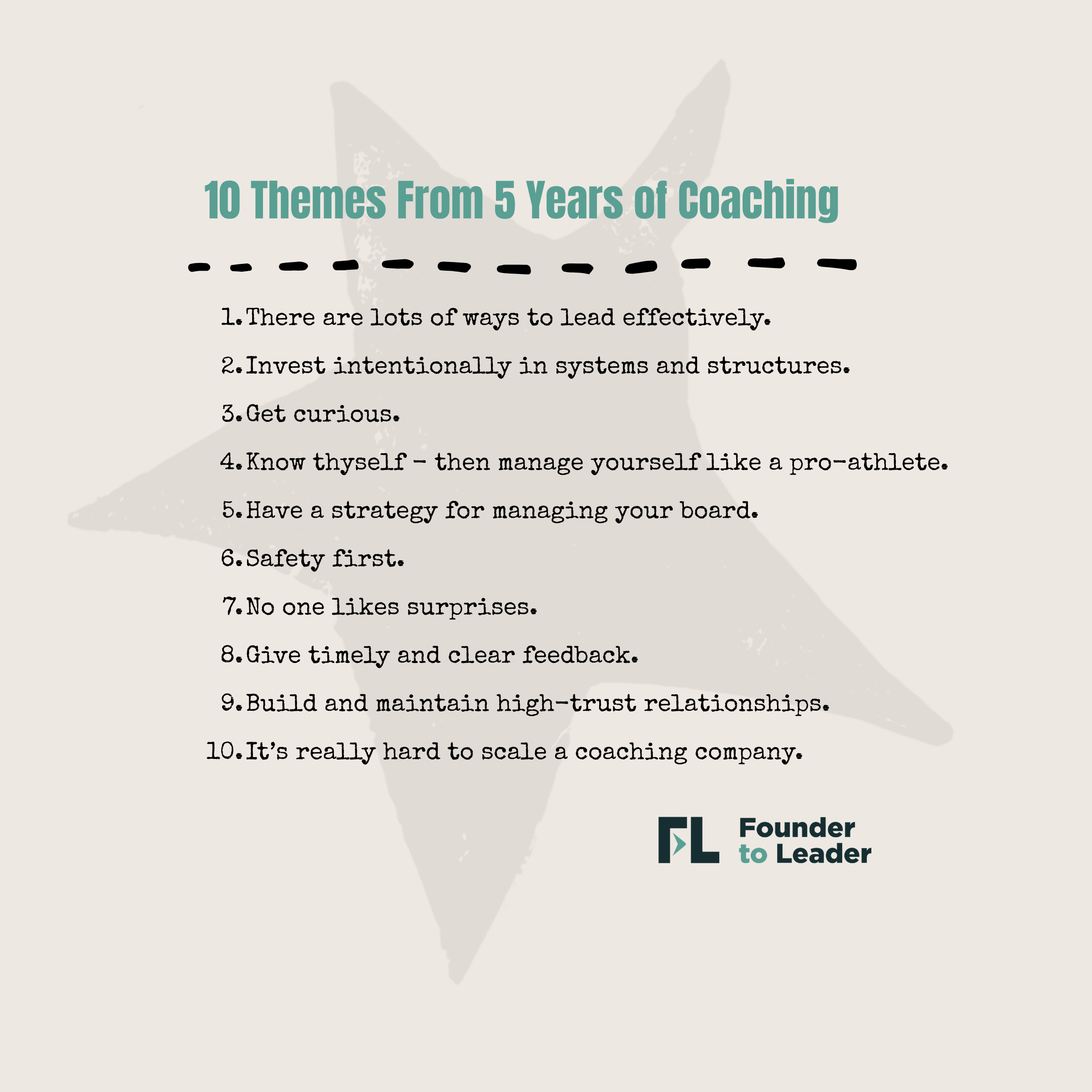
Instead, I have decided to share with you the 10 big hitter themes that have emerged in my work over the last 5 years of coaching. This approach is much more authentic for me, so let’s give it a shot.
1 - There are lots of ways to lead effectively.
Almost all of my CEO clients are worried that they are not being “CEO enough.” They question if they are loud enough, strong enough, and most of them feel uncomfortable raising their externally facing profile.
The truth is: there is no one way to lead. You have to find YOUR way to lead. And that may not look like the CEOs you see being played on TV. Most of my clients are introverts, technologists, and are brand new to this role. I always encourage my clients to look around and to take note of the people who inspire them. Think of it like you’re making your own leadership recipe and you’re borrowing spices and ingredients from the real world models that you have access to. Your job is to combine those ingredients into your own leadership secret sauce that feels authentic to who you are. You don’t have to fit into a particular model of what you think a leader should look like and sound like. As a woman, you don’t have to be Miranda from Devil Wears Prada to be seen as a badass. There are lots of ways to be an effective leader.
2 - Invest intentionally in systems and structures.
Even when you are a team of two, it pays off to have systems and structures. What I mean by that is: you and your team should align on what you are doing, why you are doing it, and how you are doing it. You need to be intentional about everything you do. How do we create goals? What meetings should we have and how should we structure them? What communication strategies should we use? Who is managing whom and why? How do we promote people on our team?
As an early stage start-up, things are evolving rapidly. What worked when we were a team of three is unlikely to work when we’re a team of six and definitely won’t work when you’re a team of fifteen. How do you design processes, be intentional about your work at each stage, and build in reflection to evaluate if your systems and structures are still working for you? That’s not to say you should change things all of the time - constant change actually makes people feel unsafe. But perhaps every quarter, when you are doing your quarterly goal setting, it’s worth asking if there are changes you need to make to ensure that your internal processes are aligned to help you achieve your goals.
3 - Get curious.
One of the most important skills to hone as a leader is asking great questions. In my Management 101 course I’m always encouraging participants to act like detectives. Doctors don’t immediately prescribe medications as soon as you walk in the room. They ask questions to get to the root cause. They collect clues. We, as leaders, need to assume less and probe more. I call it the “Five Levels of Why.” I encourage clients to go deeper into understanding what’s really at the core of the issue. It’s one of the key tenets of Nonviolent Communication.
Most miscommunication and conflict stems from misunderstanding or not understanding. The more you understand your teammates or what they are so worried and concerned about, the more they feel seen and heard and the path forward becomes more visible. The more you know your teammates, the more trust you build, allowing you to build highly effective teams.
4 - Know thyself - then manage yourself like a pro-athlete.
You know what they say in those safety trainings before you take off on an airplane? They say: “Put your own oxygen mask on first.” It’s true. As leaders and as managers we need to take care of ourselves before we can support other people. You can’t do your best work if you’re scrambling and surviving.
Being a leader is a lot like being a pro-athlete. Pro-athletes are thoughtful about what they eat, how they move their bodies, and how much rest they need to be at peak performance. Leading a hard tech start-up is quite similar actually. You have to have discipline in taking care of yourself. And one of the best ways to take care of yourself is to know who you are and what you need. When do you do your best thinking? How do you recharge? What are your strengths and how do you bring in talent and resources to complement you? How do you get deep thinking time to be strategic?
It’s very easy to be busy. It’s much harder to make sure that this job is sustainable for you and that you’re doing the right things that move the needle. The more you know yourself, the more effectively you can lead.
5 - Have a strategy for managing your board.
No matter how friendly your board members are, they have the ability to fire you. They can deny you a bonus. They can prevent you from doing what you think is right for your organization. They can also be hugely helpful by opening doors and removing obstacles for you.
Unfortunately, most of the time, boards of directors are tricky business. If you have a really positive and supportive board, count yourself extremely lucky. If you want your board to be rowing in the same direction as you, it requires a great deal of thought and a strategy about how you manage those relationships. What information will you share with them? When? How will you engage with them? How will you share bad news? Your board will happen to you if you don’t have a proactive game plan for how you want to manage them.
6 - Safety first.
As leaders, you need to ensure that your team feels safe at work. It’s one of our most basic human needs. Safety doesn’t just mean physical safety. It means the whole gamut of Maslow’s Hierarchy of Needs. For those of you who have people in laboratories, this includes making sure people don’t get hurt on the job. No one can do their best work if they are spending most of their time in “fight or flight” mode. Innovation and creativity require us to access parts of our brain that are inaccessible if we are worried about getting in trouble for speaking up or are anxious because there isn’t a gender-neutral bathroom and we don’t feel comfortable relieving ourselves at work. We need to take care of our people so they can do their best work.
7 - No one likes surprises.
Change is inevitable in an early stage hard tech start-up, but it shouldn’t feel like every day the rug is being pulled out from under you. Our job as leaders is to communicate way more than we think to our teams so that they are nimble enough to pivot and move when necessary. Sure, emergencies happen, but we want to have those moments be few and far between so you don’t burn out your team. The more we can get ahead, give warning, drop seeds of change, the more resilience and trust your team will have that your leadership is thoughtful and measured. How can you be appropriately transparent so that your team understands how decisions are made? How can you lead in a predictable manner, even if you can’t predict everything that is about to happen? Being predictable is one of the ways we make our team feel safe.
8 - Give timely and clear feedback.
Whether you have critical or positive feedback, it’s always best when it’s specific and timely. What is not working? Nip it in the bud regularly so feedback becomes a nothingburger for everyone. What is working? Name it. Call it out specifically: “I love the way you simplified that graph, the data is easy to understand.” As Brené Brown says: “Clear is Kind.” Be kind and let people know what’s working and not working, so they can succeed. Almost everyone wants to get an A+ so why not help them figure out how to achieve it?
9 - Build and maintain high-trust relationships.
I see a lot of co-founder and team conflict as a coach. I’ve helped quite a few co-founders break up after realizing the misalignment is too deep to reconcile. High trust doesn’t just happen, you have to nurture it like taking care of a finicky orchid. That relationship needs just the right light, just the right amount of water, and you have to check on it often. In human terms, this means getting to know your teammates as humans - not just as workers. The more closely you work with someone on your team, the more you need to invest in that relationship and talk about the hard stuff so it doesn’t erode your connection. If you don’t understand something one of your teammates said, go back to theme #3 and get curious without judgement. If you want to achieve big goals, get to know your people.
10 - It’s really hard to scale a coaching company.
This last theme is a bit of an internal one, but it’s been a real theme for me these past five years. Working in the venture-backed start-up world, it’s assumed that bigger is better. Scale matters. I think I got swept up in some of my initial success and started to have visions of grandeur. I went from being a one-person team, to having three coaches on the team, then five, then ten. I started to have a lot of anxiety. Balls were getting dropped. The boutique feel of my firm started to get lost. I started to get worried about risk. Coaching is a hard business to scale because you can’t hire junior teammates to do the work under you and you have no visibility as to what happens in closed-door sessions with clients.
About two years ago, I realized that “small is beautiful,” for me and Founder to Leader. I started to right-size the organization and went back to having five coaches on the team. And then, this year, I finally did a massive deep-dive with Claude to understand the business model and I realized that I’ve been far too generous with the other coaches on my team. Although I fundamentally love being on a small team, the finances do not support the way I’ve been doing it. Having more coaches on my team has actually hurt my bottom line.
I now understand how to build a successful and scalable coaching business and I have come to the conclusion that I don’t want to be in that type of business. I love doing this work and it’s simpler and cleaner to go back to being a solo operation. Of course, I will collaborate with other coaches as projects emerge, but I’ve learned the hard way that I don’t want to run a coaching firm - I’m really happy being a coach.
Looking forward
In five more years from now, I hope to be writing to you with another retrospective piece, looking backwards on ten years of Founder to Leader. I have grown so much over these past five years, helping all of you grow, too. I have tremendous gratitude for how much trust you put in me to be your confidant and strategic partner. Thank you for an incredible first five years. Let’s keep learning together.