5 years of Management 101
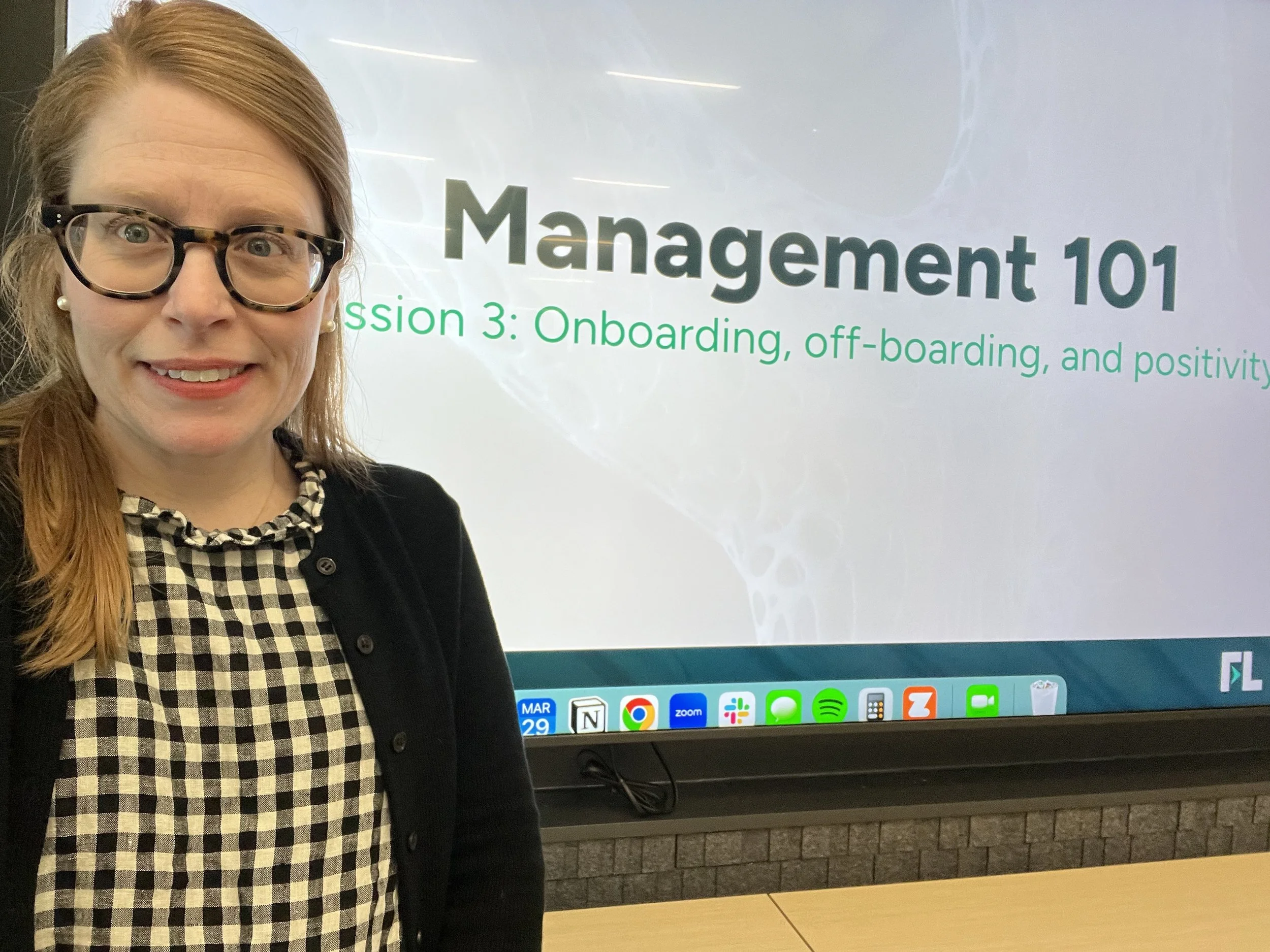
Me, teaching Management 101 at The Engine.
One of the most impactful things I’ve done over the past five years has been to design and teach Management 101. The course is a 6-week primer for new managers to understand the frameworks and principles of leading others in human-first organizations. Human-first is a phrase that reflects the core principle: to build breakthrough technology, you have to invest in the people in your organization; when your team is fully engaged in their work, you can dream big and deliver on your goals.
Here’s how Management 101 got started.
Just as I was launching Founder to Leader, the three co-founders of Concerto Bio, Cheri, Bernie, and Jared, came to me and asked me to design an efficient way for them to learn how to manage people - and fast. They were growing quickly and none of them, at the time, had, collectively, limited management experience. Over the next six months, I built Management 101 and deployed each module one month at a time for them.
The content of the course included core skills such as understanding what great management looks like, how organizational design works, how to onboard and offboard talent, goal setting, self management, mitigating bias, culture and values and leading through change. It also covered key management principles such as psychological safety, motivating others, being clear, leveraging positivity, and measuring success.
Many of you know this about me, but I actually went to graduate school for education. I received a masters degree in elementary education from the University of Pennsylvania and I taught fifth and sixth grade for several years in my early career. That training and experience deeply guided the design of the course. I tried to break down difficult concepts into simple bite-size pieces and ensured that every theoretical idea came with an accompanying worksheet or tool to immediately help participants learn how to put those ideas into practice in their own organizations. I wanted the course to be practical more than anything else.
I also made sure that, in the design of the course, participants were deeply engaged in their own learning and there was a safe space for them to practice thinking and acting like a manager. I wove into each module many real world scenarios I have faced as a coach with startups just like the participants’ own organizations. I wanted to make sure that participants were wrestling with hard manager situations so that they could feel more confident walking back to their own organizations after some practice in a controlled environment. In the class I purposefully did a lot of “think-pair-share” - i.e. I’d have the group break into pairs to brainstorm how to handle these scenarios while also helping them build a peer group of new managers. I modeled a lot best practices while teaching - from the way I start each class with an emotional check-in (“On a scale from 1-10, how are you doing today? Show me with your fingers”) and always having a clear agenda and two takeaways per class.
I can’t thank the Concerto team enough for asking me to build Management 101 for them; it ended up that lots of folks wanted a similar training. Other startups started hiring me to run this training for their teams. I started to offer to host Management 101 on my own virtually, and then organizations like The Engine and Activate invited me to start teaching the course for their communities both in-person and virtually. I now run Management 101 twice a year for full rooms for both organizations. I have enormous gratitude for The Engine and Activate for signaling to their communities that management matters by offering my course.
I was trying to figure out how many leaders and managers have taken my course over the last five years and I estimate that at least 500 early stage hard tech managers and leaders have taken Management 101 by now. This is not just the CEOs but also C-suite members, middle managers, and soon-to-be managers as well.
My driving motivation to build Founder to Leader was to have an impact. I wanted to help these brilliant scientists and engineers have the greatest likelihood of success. It ends up that it’s actually not the technology that’s the hardest part of launching and scaling - it’s doing this important work with other people.
And yet almost none of the folks who have raised capital to take their innovative research and bring it to market have any experience whatsoever leading or managing other people.
The only model these technical leaders have of these skills are their academic PIs - and most PIs don’t view management as part of the job. Almost everyone who has taken my course knows what it feels like to be mismanaged. They know they don’t want to do that to their own team, and yet they have no idea how to do better.
Looking back on the feedback from course, participants have shared their greatest takeaways from our time together:
Being a great manager requires a great deal of thought and care.
Every manager needs to meet with their direct reports weekly.
Even tiny teams still need systems and structures.
Giving critical feedback is uncomfortable and has to be done regularly.
You have to invest in managing yourself in order to support others.
Being clear doesn’t make you a micromanager.
Management is something you learn and requires lots of practice.
No one is perfect and empathy is important.
Those feel like valuable lessons; they make me feel proud that Management 101 is making a difference.
As someone who is always looking to learn and grow, I am never fully satisfied with the course. I keep modifying the content with new quotes from books I’ve read, new formats, new scenarios from clients and such. It feels like it’s like a fine wine that just keeps getting better over time. Activate just asked me to weave in hiring team members and advisors. I added in a new section on conflict and predictability as well.
One thing that warms my heart deeply is the fact that no one is making participants take Management 101 – they want to take it. These emerging managers and leaders choose to take time out of their busy schedules to show up and learn this content because they believe it is important. That, alone, makes me feel hopeful about our future - not only because of the technologies that have a higher likelihood of making it to market but also because it means that the leaders of these organizations care about making their organizations places where humans thrive.
Here’s to five more years of Management 101.