Graphic design basics, with Katie Okolita, CEO of OKOK
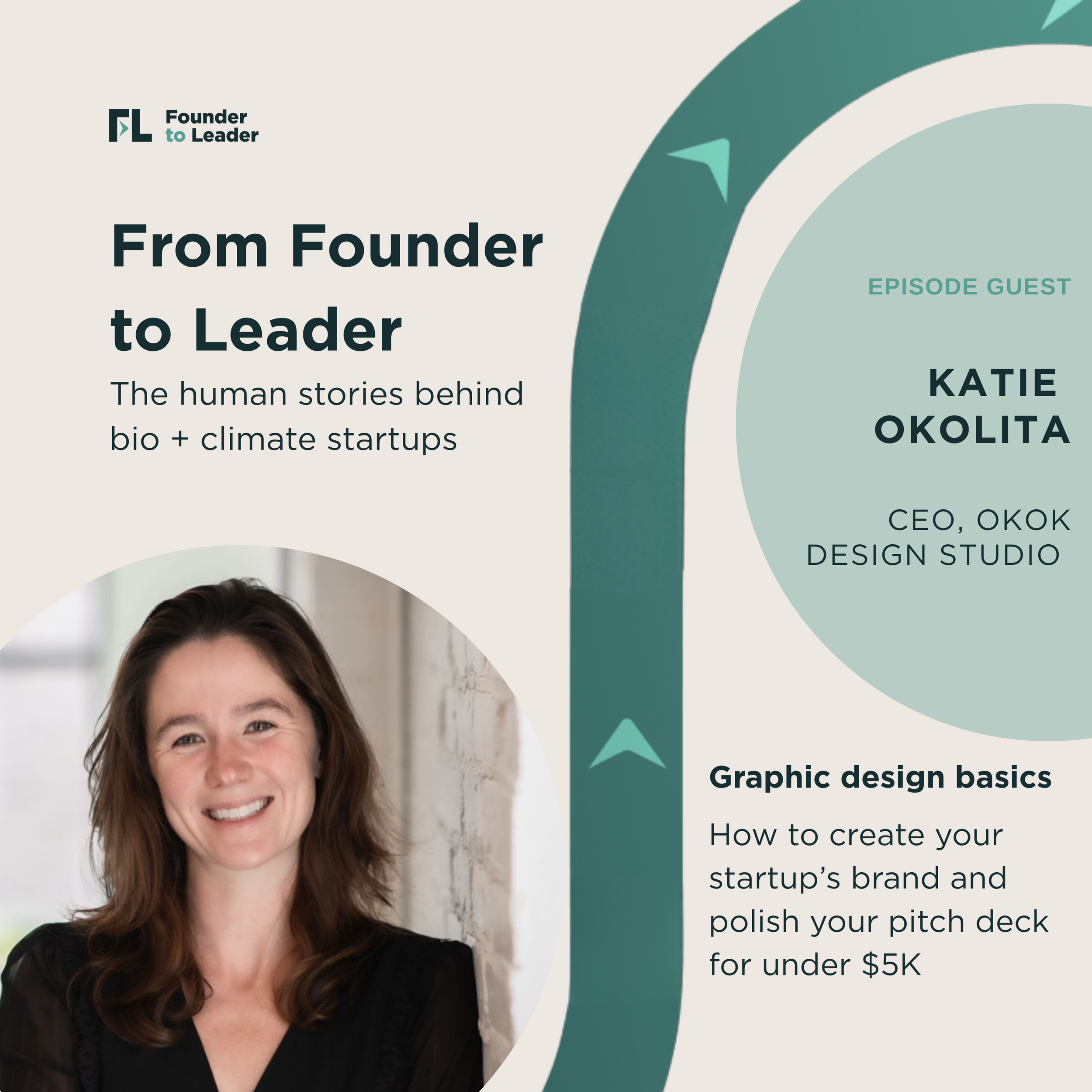
Katie Okolita, CEO of OKOK Design Studio
JAYE: Welcome to another episode of From Founder to Leader: the human stories behind bio and climate tech startups. In this episode, we're demystifying what it looks like to build a hard tech startup from the ground up by sharing the real human stories behind the headlines from the people driving innovation. Today, we'll be talking with Katie Okolita, the CEO of OKOK, a design studio that does branding, web design, and graphic design for early-stage hard tech startups. It is such a treat to have you here with me today.
KATIE: Thank you, Jaye. It's lovely to be here.
JAYE: So talk to us a little bit about your background and how you got into design.
KATIE: I got into design pretty early. My dad was a tech guy, a computer scientist. He worked for Symantec Corporation, so he always had computers in the basement with desktop computers early on in the 90s. I joined this website called Horseland, which was a browser-based horse sim game. I was probably around 8 or 9 years old. You could train your own horses and do all these things online, and one of those things was customizing your own barn homepage through HTML and CSS. It was old school; you actually had to go in and code these barn home pages. That's how I initially got into web design and development. I started by ripping somebody else's horse barn home page, copying it, bringing it over, and tweaking a few things. She totally called me out on it, which was fair. But that's kind of how you learn, right? You pull it apart, fiddle with the code, and figure out how things broke and how to fix them. I quickly started selling my services on Horseland for Horseland dollars, building websites and home pages for people's horse barns. I knew going into college, and all throughout high school, that I wanted to do web design and development. That's how I initially got into this. Throughout the years I've worked with design and dev studios in Boston, New York, and Phoenix — kind of all across the East Coast. Back in my early 20s, I decided to go off on my own and did a little stint with a venture capital firm. But for the most part, it's been building my own design and dev studio.
JAYE: That is a great story. I actually did not know that. And for those of you listening, Katie is a huge horse fan, so that completely adds up. Just a little bit of context: Katie and I met when I was at Petri, which later became Pillar VC. She also does a lot of design work for many of our clients at Founder to Leader.
So Katie, let's talk a little bit about when a team should think about creating a brand, a website, or a polished pitch deck. When do you think is the right time for early-stage startups to do those things?
KATIE: It really depends on the industry the company is in. But I would say roughly, you want something as soon as you start going out to raise. And it doesn't need to be highly polished, especially if you're at pre-seed or seed stage. A polished deck doesn't necessarily mean bringing in 3D graphics and a super robust brand. It just needs to be simple and understandable. Investors need a place to land if they Google you, so it can even just be your logo and a contact email on a splash page. Especially at the pre-seed stage, you just need someplace for people to land and figure out that you're a real company. And then a deck that just looks cohesive. You don't need to look like a Series A or B company; it just needs to be clear, concise, and tell a good story. The design shouldn't inhibit the story; it should support it. I think a lot of founders get bogged down in making things incredibly polished right at the start. But a lot of times, early-stage companies are going to pivot in a year, change the name, and need a new logo. Make it nice, but don't spend an incredible amount of time on it too early. Don't overthink it.
JAYE: Should folks think about hiring someone like you at this stage? Or should they plan on buying a Squarespace and using some templates? What do you think is the right use of resources at the earliest stage?
KATIE: I think it depends a little bit on how tech-savvy of a founder you are. I think most of the people listening to this podcast are going to be pretty tech-savvy. So especially in the pre-seed, going out to raise seed, you don't necessarily need my help. You can utilize a lot of different AI tools to help you; just don't overcomplicate it. Don't just dump your pitch deck into a website generator and put the whole pitch deck up on the website. You don't need that, and you're going to get bogged down in the details if you try. So use AI tools to help you iterate and think through things. Keep it simple. You don't necessarily need to hire someone at pre-seed. And if you do hire someone, don't hire a huge design agency that's going to charge you $80K for a whole brand kit, website, and pitch deck. You don't need that at that stage. Fiverr (a site where you can hire freelancers for pretty cheap) can be a little bit of a management challenge, especially when you're very busy. But they can help you get a nice logo if you just hire someone to do a couple of logo iterations. You can also try with AI, just being careful not to let it over-design. Think about the logo simply. No logo is better than a logo that looks obviously AI-generated.
JAYE: When you're thinking about beginner branding for a new startup, what are some of the things you think about when doing this work for clients?
KATIE: Number one with the logo: think about simplicity and how it scales. A lot of people put way too much detail in their logo, and by the time it becomes a little icon on your website or on a business card, you can't make out the detail. So keep it simple. Clean typography — choose a typeface that's not Arial or Calibri. Try something from Google Fonts, which has a huge database of open-source fonts you don't need to pay to use. They look a little more unique than Calibri, Arial, or Helvetica. But again, keep it simple and readable at scale. Don't use a script font, it's one of the worst things you can do.
So I think about things like readability, scale, sizing, and contrast across different colors. For decks, I prioritize adaptability over design touch for early-stage companies. Obviously you want the design to help tell the story, but realistically an early-stage startup founder isn't going to be able to iterate with a designer back and forth through the many iterations a deck takes. So editability is key, and keeping things very simple in the deck. Use your brand colors and logo consistently. One of the best things you can do is think about margin and padding: keeping them consistent. Don't let your text run into the edge of the page. And for a landing page, it doesn't need to be complex. So many people stress about the website and overcomplicate it. Put up your logo and an email, that's really all you need.
JAYE: I love that. So what tools do you suggest people use to get started?
KATIE: There are a bunch of different tools out there.
ChatGPT is pretty good at image generation, so you can start exploring a logo there. You can also reference inspiration channels.
Pinterest — love it or hate it, it's full of AI-generated content these days, but you can use it to start exploring different styles and logos you might want to try. Dribbble is another website with a really great resource for different brand kits and designs.
There's another site called Are.na that is a little more trendy — more for Gen X or Gen Z type content. Really trendy design, which isn't necessarily what you always want in pharma or biotech, but could work for sustainability if you want to be a bit more forward-looking. Are.na is a great site for that kind of digital content and inspiration.
Also, look at your competitors. Coolors is great for expanding a brand once you establish that base.
So choose a font from Google Fonts, do a simple logo, pick a color or two, and then Coolors can help you expand that brand into complementary colors. It'll give you a very basic tech template, which often requires tweaking, but it gives you a good starting base. It can even give you different heading styles. You can download it, get hex codes and colors, and start using them in your brand assets. From there, you can start adapting them into a simple landing page design. You can also give Coolors some direction — like 'I like this website' or 'I like this style' by uploading screenshots or links to help it architect a V1 of that brand.
JAYE: So once you're ready to go from brainstorm to execution, what do you do next?
KATIE: It depends on where you're starting from. For polishing your deck, most people use PowerPoint or Google Slides. If I could convince more people to start using Figma, I would. Both PowerPoint and Google Slides are not really design software, and they're a bit older. There is a learning curve to learning something new like Figma or Canva, but they tend to be more robust.
Anyway, taking your design into PowerPoint or Google Slides, one of the biggest things you can do to start polishing your content, assuming your content is ready for your pitch deck, is to go into your deck or template settings and put in rulers and guides that show you where to keep your margins from elements and from the top of the deck. You can apply general standards for how charts and graphs look.
And then think about less is more. Too many people put too much content on a single slide. Think about breaking it up into more concise, digestible content. Short sentences. Bullet points. Call out the important points in bigger text, with numbers, things like that. For the website, there are a couple of really good platforms.
Squarespace, as you mentioned, is a pretty easy drag-and-drop interface with super cheap plans. Another good platform is Framer. Webflow I almost wouldn't use for an early-stage company. It can be more robust, but it has a bigger learning curve. Framer is a nice in-between if you're pretty tech-savvy and design-savvy. It has a drag-and-drop visual builder. You can even pull screenshots that Coolors created for you and give it to Framer as a prompt. And if you do end up learning Figma, another shortcut is that you can take Figma frames straight into Coolors or into Framer or Webflow. Lovable is also a great tool for people who just want to get a very simple website up. It lets you prompt-design a website, just being careful not to end up looking like a generic AI-generated site. Simplicity is better. Try to avoid obviously AI-generated imagery and icons that don't quite make sense.
JAYE: How do you spot something that's clearly AI-generated?
KATIE: This is something you kind of have to develop an eye for by seeing it and working with AI content. You can look for artifacts that don't make sense, like something in a photo that just doesn't look right. Hands are always a good one; AI is terrible with hands. A lot of times it's about looking closer at the photo and asking, does this look real? Or does it look like something that's obviously AI? It's almost too polished; it has a certain sheen. Another thing I often recommend is just asking people: does this look AI-generated? You can certainly use AI-generated imagery if it's polished and doesn't look obviously generated, but you really don't want to run into a situation where you lose credibility because it looks like somebody spent five minutes prompting a website and throwing up AI-generated content. Investors are getting pretty savvy to that.
JAYE: Yeah, it says a lot about your reputation, right?
KATIE: Exactly. And less is more. If an image isn't great, don't use it. If it doesn't add value, don't use it. So many people put in an abstract image just to fill space. It's better to not use something and use nice clean typography instead to get your point across.
JAYE: So what kind of budget should people be setting aside for design work across the various stages: pre-seed, seed, and Series A?
KATIE: Pre-seed, you can probably get away with doing most of it on your own. You could hire someone for a couple hundred dollars to come in and give you advice once you have a site up or reach out to a designer or a design-savvy friend and get a gut check. At the seed stage, you could probably budget around $4,000 to $5,000. That will get you a more polished logo, a brand kit, a PowerPoint template, a website, and something like a header and footer for Google Docs or Word docs, just something to start making you look more polished and brand cohesive.
Once you move into Series A, it really depends on the type of company you are. If you're a SaaS company, you're going to spend a lot of money on a marketing website, but I would assume no more than around $30,000 for a website. Moving into Series B, you might start getting into more agency relationships or building out internal teams and marketing materials.
JAYE: If I were the CEO of an early-stage startup looking to find a designer that would be a good match for me, what would you advise me to do as I'm exploring my options?
KATIE: Ask your investors. They will often have a ton of resources, and they'll probably be investing in your area, so they'll have designers specifically used to working on your type of startup. Ask friends and ask other startups. Referral is the best way in this industry. And keep in mind, especially the earlier stage you are, not to go for a $30,000 to $40,000 branding exercise too early. It's definitely incredibly useful as you scale and grow, but it's not something you need to be swindled into too early.
JAYE: Out of curiosity, how many startups do you think you've helped at this point?
KATIE: That's a good question. I would say hundreds, between decks and websites. I've been doing this for almost 20 years now, so I've built quite a few websites and quite a few pitch decks. Safe to say in the hundreds. And at that point, you start to recognize what's working and what's not. Sometimes I get a deck and I'm like: the story isn't quite there yet. You can tell that even the best design doesn't change a story or save a company that clearly isn't going to raise. That's a through-line you begin to see, having worked in venture capital when we worked together, Jaye, and also just having seen quite a few of them at this point.
JAYE: So it's helpful to work with someone to get that story really well done and to make sure you're showing the right data before you bring a designer in to polish it up.
KATIE: Yes. Especially at the earlier stages, pitch decks need to be built for flexibility. You're going to be changing your story quite a bit. But as you get to the later stage and you're raising quite a bit more money with a lot more riding on the deck, wait until it's pretty solid. It's never going to be 100% right. Decks pivot and change based on investor feedback and the pitches you take. But don't bring in a designer too early when you're going to end up remaking every single slide. It's a waste of time. Or if you get late enough in your company-building, you can hire a designer to come in and do every iteration, but it costs money and takes time for a designer to do turns.
JAYE All right, Katie…what are your absolute best tips for our listeners?
KATIE: I'll reiterate the one I've mentioned a few times: don't over-design too early. Don't stress about putting up a website that's perfect, full of content, and has every bit of research you've ever done. Just get something nice, a place for investors to land if they're Googling you. Don't let the design of the deck stop you from moving forward with the story. A lot of times I find founders want to see the design before they refine the story, but as we've talked about, it takes time for a designer to come in and help refine the deck. Definitely leverage AI tools; don't be afraid of them. But still use your judgment at the end of the day. You still know what's great for your company and what's differentiating about you.
JAYE: Katie, thank you so much for taking the time. A lot of people are always wowed by the work that you do, and it's a bit of a magical mystery how you get there. All of these insights are really helpful for folks, especially as they're trying to do some self-serve work at the beginning, before they have a ton of resources.
Some of Katie’s favorite resources + tools:
Google Fonts — Open Source Fonts
Image gen: ChatGPT / Nano Banana
Design: Figma / Claude Design / Google AI Studio
Website: Squarespace / Framer / Lovable / Bolt.new
Icons: Font Awesome / Lucide Icons