Retreats
WHY HAVE A RETREAT?
Retreats are a great way to carve out time from the everyday hustle and bustle of startup life to do deep and meaningful work with your team. Whether you do it on-site or off-site it’s extremely useful to take a pause from doing to align people, strategy, and resources - and to build meaningful relationships that will help you collaborate more effectively.
How often should we have retreats?
At a minimum, it’s helpful to have an annual retreat - typically at the beginning of the new year to set goals and re-energize. You could do a retreat once a quarter if you want, to align with the OKR goal-setting timeline. It’s entirely up to you how often you want to host retreats but keep in mind that it means taking several people (or all of your team) offline and has budgetary implications as well to do it well.
Who should attend?
Who should attend your retreat should be determined by your strategic goals for the retreat. It’s a good idea to start first with your objectives and then to figure out who needs to be there. Keep in mind that everyone who joins your retreat will not be contributing to their normal work for the duration of the retreat, so you may want to think really carefully about the implications this will have for your team.
How long should the retreat be?
Again, the length of your retreat should be determined by your goals. You can have a 1-day retreat if everyone is local. If travel is involved for some - or many - of the participants, 2-3 days of working time may be the right retreat length to make the travel time worthwhile for everyone.
Where should my retreat take place?
Some startups always pick their headquarters as a home base for retreats and other startups like to rotate locations to “visit” employees in their home cities, or pick interesting locations that are neutral for everyone. While exotic locations are lots of fun, they can also be significantly more work to coordinate and organize logistically. You may have fewer resources to support you in remote places as well. If you plan to bring your own facilitator or coach, that can free you up a bit because you don’t need to vet local talent if you plan to have support leading the meeting.
YOUR RETREAT AGENDA
What should we do during our retreat?
Let’s build our agenda by starting first with your retreat goals. What are you hoping to achieve? Do you want to do goal setting? Do you want to name your company values? Do you want to make strategic crossroads decisions?
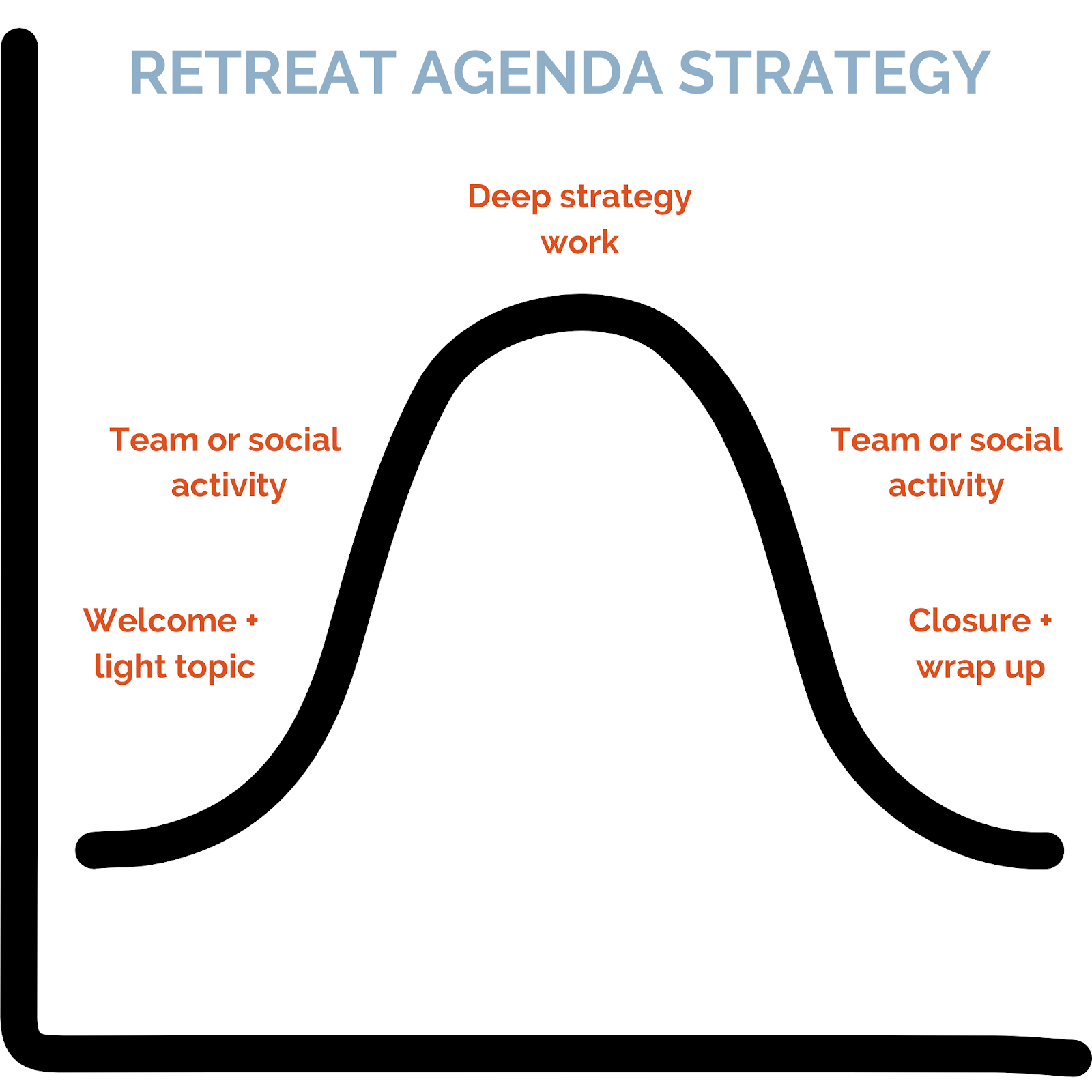
Whatever it is that you want to do, it’s helpful to think about your agenda as a group norming arc - an emotional bell curve so to speak:
The big picture strategy is that you want to create your agenda such that it aligns with Tuckman’s stages of group development:
Forming
Storming
Norming
Performing
That is to say, you want to start the group off with the lightest, most accessible content to warm everyone up. Then you do some activities that strengthen group trust and deepen relationships before slowly increasing the “riskiness” of the content you’re tackling. You want the hardest content to be covered during the safest time of your retreat. Then you want to start lightening it up and providing closure for the group so that they can segue from the retreat back to everyday company life.
One-day retreat agenda:
9:00 - 10:00 Welcome, reflections since our last retreat, retreat goals
10:00 - 11:00 Goal reviews by department area
11:00 - 12:30 Kayaking / hiking / archery / obstacle course / puzzle
12:30 - 1:00 Lunch
1:00 - 3:00 Naming our company’s values workshop
3:00 - 4:00 Weaving company values into company life, wrap up + next steps
4:00 - 5:00 Happy hour + closure
Three-day retreat agenda:
Day One:
3:00 - 4:30 Welcome, reflections, retreat agenda
5:00 PM - 7:00 PM Welcome dinner
Day Two:
9:00 AM - 11:00 AM Goal review
11:00 AM- 12:00 PM Travel to adventure location
12:00 - 1:00 Picnic lunch
1:00 - 4:00 Team adventure (winery, apple picking, rock climbing, etc.)
4:00 - 5:00 Travel back to site
5:00 - 6:00 Quiet or individual time
6:00 - 8:00 Dinner
Day Three:
9:00 - 11:30 Deep strategy work
11:30 - 12:00 Break
12:00 - 12:30 Lunch
12:30 - 2:00 Wrap up, next steps + closure
2:00 Travel home
Inclusion + Accessibility Considerations
Whatever you decide to do on your retreat, make sure that everyone can participate equally. If you have a teammate in a wheelchair, rock climbing is not a thoughtful activity. If you have someone who is a vegetarian, perhaps visiting a meat farm is not particularly sensitive. If you have someone with a shellfish allergy, you may want to rethink that lobster bake. Make sure to collect information from your participants ahead of your planning time to make sure you’re taking everyone’s needs into account. When you ask your team to go away with you, they are trusting you to take care of them and their needs during the time away.
Make your team feel super special
A retreat is a great time to show your team how much you value them. Consider leaving them with a welcome bag in their room upon their arrival with some snacks, an agenda, and a little present so they feel welcome as soon as they arrive onsite. Perhaps you order some special swag for everyone and it’s waiting for them at the first meeting? Maybe you even hand-write a note of appreciation for each participant and give it to them at their seat at dinner. Think about little things you can do that show your team that you see them and value you so they feel super special.
Logistics and details really matter
There’s nothing worse than having the logistics get in the way of your strategic goals for your retreat. Have someone on your team who is exceptionally good at operations think through every possible detail and have backup plans if hiccups occur. It’s helpful to have a runner on the team whose sole responsibility is to ensure that everything runs smoothly - the transportation is on time, and the food is ready when you need it. You don’t want to have to sacrifice the participation of a key attendee to solve these issues. If the operations have been planned and executed effectively, the team is unaware of all of the hard work that went on behind the scenes that allowed them to connect, strategize, and engage meaningfully in the retreat.
Wrap it up
As a retreat comes to its end, it’s always important to think about how to help the team transition back to your company. What are the next steps and how are we doing to integrate the work that we have done into our startup’s life moving forward? It’s helpful to share back with the larger company some memories and take-home messages as well so they aren’t feeling like super secret stuff happened and they’re in the dark.
Conclusion
A thoughtfully planned and well-executed retreat can help take your team to the next level. Just remember, before you send that calendar invitation to everyone to go through the exercise of planning out your goals and then working down to the weeds to make sure that the ROI is there for your company.