Time Management Strategies
One of the most valuable commodities in any startup is time. In biotech startups, time plays a particularly interesting role because some biological processes simply cannot be sped up. It becomes even more essential, then, for early-stage biotech founders to figure out how to pick up the pace anywhere possible to counterbalance the constraints of experimental science.
So, when you’re working at warp speed, how do you make sure you’re spending time on the right things? How do you make sure your day is busy with the most valuable stuff? It’s a healthy CEO habit to look at your calendar and constantly optimize.
THREE WAYS TO THINK ABOUT MANAGING YOUR TIME:
1. The strategic approach:
One way to check yourself on time management is to do backward design planning. Start first with the big picture and then work your way down to the weeds, like this:
Vision: What would it look like if we were wildly successful in the next 5-10 years?
Mission: Your company’s thesis of change to produce the desired outcome.
Annual goals: What we need to do this year to head towards our longer-term vision.
Quarterly goals/OKRs: What needs to get done this quarter to stay on track?
Weekly goals/OKRs: What needs to get done this week to hit our quarterly goals?
Daily tasks + goals: What do I need to do today to hit my weekly goals?
As you go down each layer of detail, refer back to the bigger goals regularly to make sure you are spending your time on high-value activities that will help you meet your goals.
2. The proportional approach
Another way to think about time management is to create a bottom-up framework. How much of your week or month should be spent doing which activities? For a founder, it might look something like this:
Investor relations: 20%
Leading/managing the senior leadership team: 20%
Product/market fit - customer discovery 20%
Overseeing hiring: 10%
Networking + external relationship: 5%
Administration (email, etc.) 5%
Use these quantifications to look at your week and month and make sure your time allocation is right. What needs more time and attention? What needs less? It can be helpful to take a big-picture look once a week at how this breakdown of activities is going.
3. The functional approach:
It’s also valuable to think about time in relation to your basic human needs. You need to protect your time to be your best self, which could include:
Getting exercise daily [30 min]
Getting showered + ready [30 min]
Doing quiet work alone daily [1 hour minimum]
Eating lunch [30 min]
Planning your day + email [30 min]
Wrapping up your day [30 min]
Putting it all together:
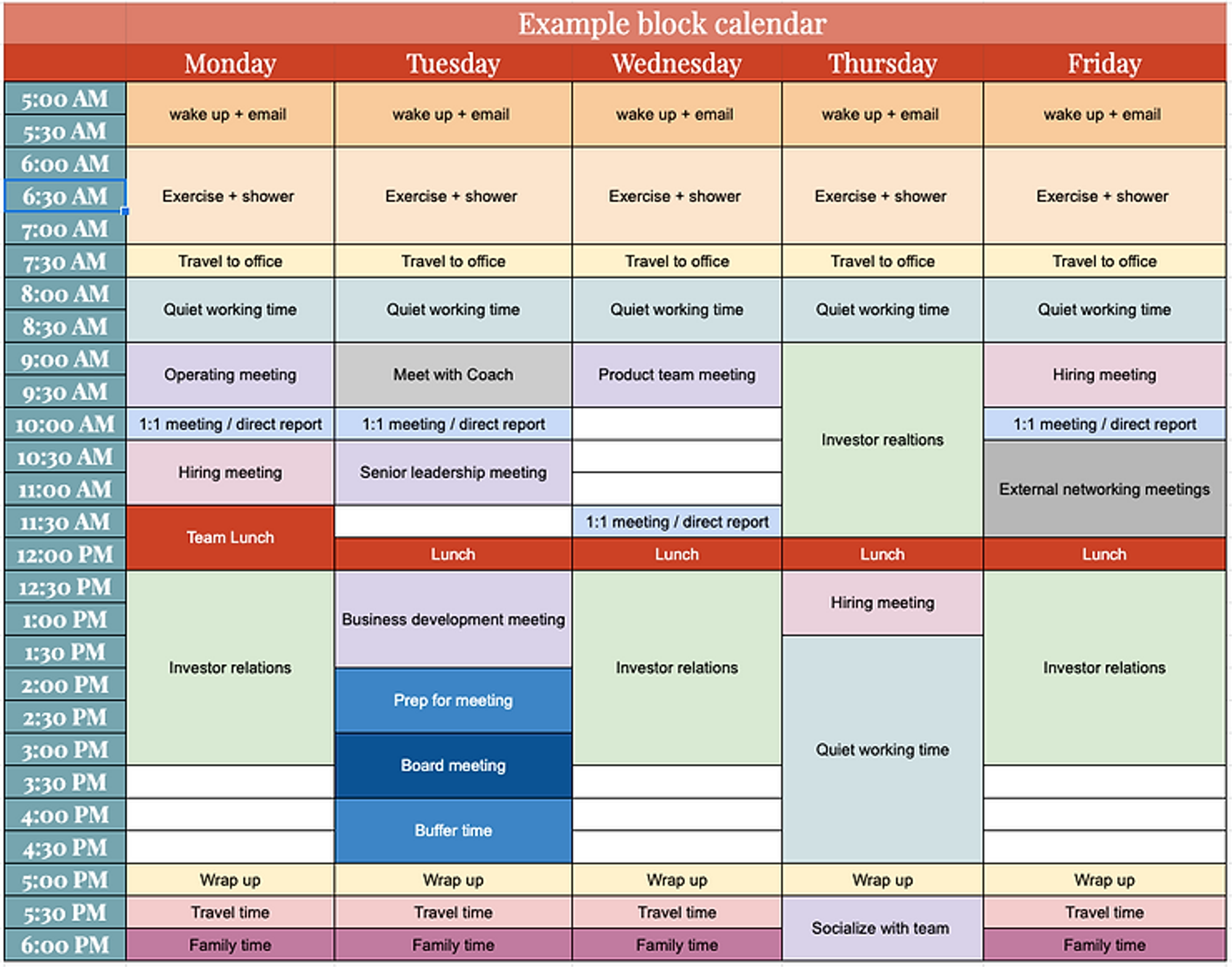
Once you think about how to use your time through all three dimensions - strategic, proportional, and functional - you can then map out your week in Google Calendar. Wherever you can create recurring time slots, we encourage you to do so. Block your time very deliberately to maintain control of your day, while still allowing the flexibility to use Calendly or other scheduling apps to speed up one-off meeting scheduling.
At the start and end of each week, you should be looking ahead to look out for double-bookings and make sure you’ve added in travel time, buffer time before high-stakes meetings, and prep time for any meetings that require you to create materials like slide decks and agendas.
Here's a sample block calendar: