
Delegation Guide
Delegation is a critical leadership skill. You absolutely cannot scale an organization by doing everything yourself. You also can’t let go of absolutely everything either or else you cease to have any control over the company. Delegation, then, exists in the grey zone - i.e., you have to figure out which decisions you need to keep close to your chest, as a leader, and which ones you release control over to someone else.
Here’s a framework to help you think about what to delegate to others:
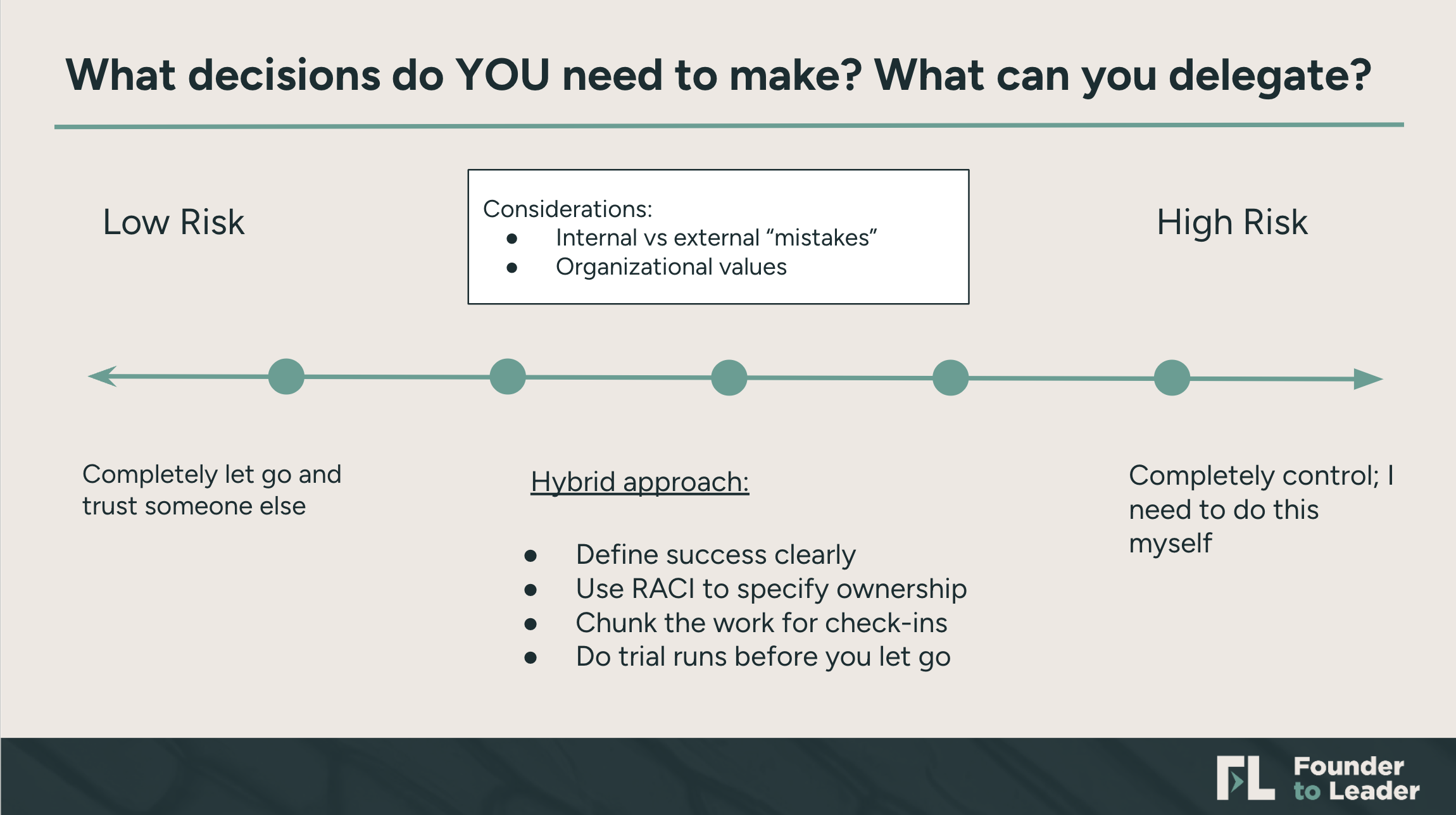
When deciding whether or not you want to delegate a task or project, ask yourself first: How much risk does this expose for the organization? If things went horribly wrong, could I live with that outcome - or would it open up an existential threat to the company’s existence? The higher the risk, the less likely we are to empower someone else to be the accountable person in a decision-making matrix (like RACI). These sorts of risks are often externally facing or represent company values.
The less risk involved, the more likely we are to let go and enable someone else to lead. Another framework for deciding if the work can be delegated - and how much - is to ask if there is only one desirable outcome - or if there is a range of outcomes that could be successful. If you have a very clear image in your mind of what the finished product looks like, then you may want to save that one for you to do yourself. If you can be a little more flexible, then it might be a good candidate for delegation.
We strongly suggest building up to letting go entirely and scaffolding your release of control so that the transition happens in a slower, more gated way - or a “hybrid” delegation approach. This is not micromanaging; this is leadership. This approach ensures you are aligned on the process and outcome. It is much harder to take back someone’s decision-making or delegation power than it is to slowly increase their accountability and ownership.
Here are some strategies you may want to try to begin the delegation process with someone on your team:
Define success early on
In a kick-off meeting, be explicit about what success looks like. What are your expectations in terms of process, outcomes, time, budget, human involvement, etc? The clearer you can be about the criteria that need to be met, the more likely someone is to succeed. You can schedule check-ins to track the process and keep you updated, but if you establish guiding principles ahead of time, the person you delegate to can operate more or less independently as they execute - so long as their decision-making matches these predetermined goals and objectives.
Use a decision-making matrix to specify ownership
Where and when do you want to have input and when can your leader run with an idea on their own? If you can map out which topics or areas need consultation, or specific sections of the work that you want to weigh in on, the easier it is for someone else to know when to loop you in - and you can avoid conflict by proactively knowing how and when to engage other people in the process. You can learn more about accountability matrices here.
Chunk the work for check-ins
It’s helpful to chunk the work in a more open-ended or longer-term project or task by milestone or timeline so that someone can sprint with autonomy and then check back in with you for alignment before sprinting again. This ensures that your leader never gets too far down a path without a checkpoint to align.
Do a trial run before you let go
This is particularly true of lab-based experiments. Having someone show you physically how they would run the equipment or pipette is often a great way to build their confidence and to check to make sure someone is comfortable going through all of the steps before you let go. This is particularly good with repetitive tasks so that you can catch a mistake or misstep before it is repeated several times.
As you begin to delegate, make sure you are offering positive and critical feedback regularly so that you can help your teammates learn and grow positively. Once you can comfortably let go and you know your team has got it, you can really start to pick up speed and scale your impact.