Launching + scaling metascience organizations, With Dr. Adam Marblestone
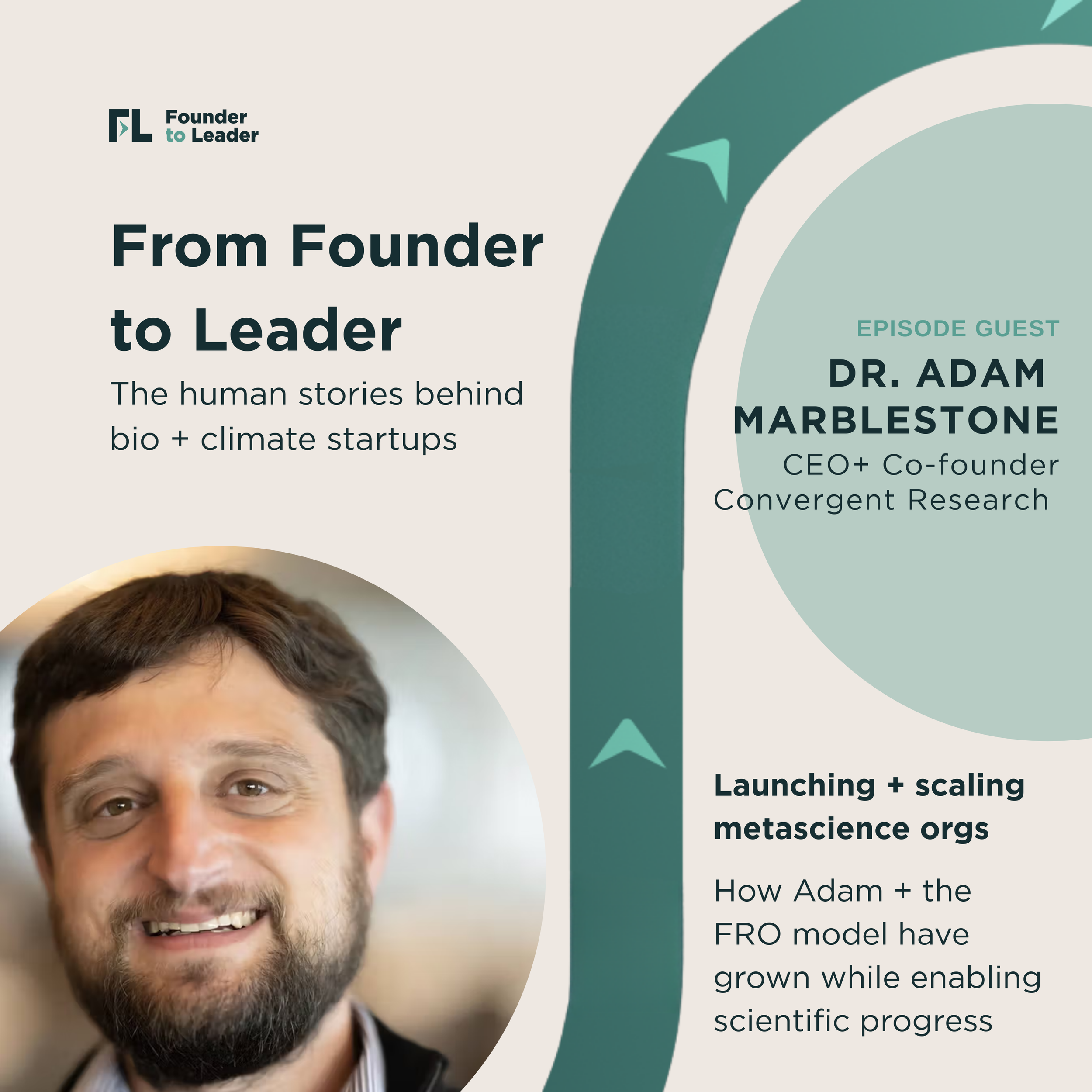
Dr. Adam Marblestone, CEO + Co-founder of Convergent Research
Jaye Goldstein: Welcome to another episode of From Founder to Leader: The Human Stories Behind Bio and Climate Tech Startups. In this podcast episode, we are demystifying what it looks like to build hard tech startups from the ground up by sharing the real human stories behind the headlines from people driving innovation. Our guest today is Adam Marblestone, CEO and co-founder of Convergent Research. We're going to be talking with Adam about launching and scaling meta-science organizations. Adam, thank you so much for joining us.
Adam Marblestone: Thank you for having me. Thank you for being a great coach to me and many FROs.
Jaye: Truly my pleasure. So tell us a little bit about you and your background and any experience you had before launching Convergent Research.
Adam: I'm really a scientist by training. I still think science is probably my zone of genius more than many other elements. I did a PhD in biophysics. I got very involved in the academic side, and then later in some brain-computer interface companies in the neurotechnology field and various attempts to make neuroscience-related technologies more scalable. I was a research scientist at DeepMind for a couple of years, and then I took a fellowship essentially to develop the idea—or find the idea—behind what became Convergent Research.
Jaye: So looking back, do you think you've always kind of been an entrepreneur?
Adam: It's an interesting question. I think not necessarily. I wouldn't necessarily say that. I remember going to college and at the time my head was 100% in physics books. Basically, I was just thinking about science and technology. I cared about the impact, but I was very much in the science, and it wasn't until I got to college—it was the first time that I met anyone really who was going about their life thinking, "Oh, I'm going to go start startups, or I'm going to start businesses." And it was just a very different philosophy. I actually remember finding it quite unusual and foreign.
Through my scientific work, I ended up having various intersection points with the Silicon Valley world. I was a PhD student in the Church lab, and he was also spinning out lots of biotech startups, and people were starting to think about that. I was involved as a kind of semi-academic co-founder of a small company called BioBright around 2012. That grew out of frustration with the difficulty of tracking what was going on in lab experiments, which is still very much a real problem as we're thinking about AI plus the lab or lab automation—sort of understanding what happened in a lab experiment. So I was involved in that. That was then the first time I was actually formally involved in a startup, but I was a little bit more on the academic kind of co-founder role. I wasn't like a full-time CEO. I was helping them get funding and refine the idea and so on and sort of along for the ride.
And then I was Chief Strategy Officer at Kernel, which was this brain-computer interface startup that was backed by Bryan Johnson. And that was a different kind of experience because we were starting with a bunch of funding because it was essentially initially mostly self-funded by Bryan. And so then I saw the kind of very rapidly moving deep tech startup. And that then was very influential in terms of my thinking, "Wow, this is way different in terms of how it operates compared to academic labs that I've worked in," and has different affordances that I then wanted to apply back to the Focused Research Organizations that Convergent has been developing.
Jaye: So tell us about Convergent Research. What is it? Can you explain it to everyone?
Adam: So we are an incubator and a parent organization for a category of project that we call Focused Research Organizations. I think we're the first FRO incubator in the space and have been very much involved in promulgating the concept also to other organizations. And these are nonprofit, startup-inspired science and technology research organizations. They often build scientific infrastructure. So I think about things like the Hubble Space Telescope. This was a piece of scientific infrastructure that was built for the astronomy community that was totally transformative to the field of astronomy, but it wasn't itself an astronomy discovery, nor was it a traditional commercial-type startup. It was an industrialized approach to building scientific infrastructure. So we've developed ten, going on 12 or 13 of those in different fields—biology and otherwise.
Jaye: Convergent Research considers itself a meta-science org. Is that correct?
Adam: Yeah. I think that we can definitely be placed into that category. There are lots of interesting questions about what is the emerging set of types of meta-science orgs, but we could get into that or not.
Jaye: Why is there a need for these types of organizations right now?
Adam: Yeah. So to reframe the observation: if you go back to the first half of the 20th century, there was a bunch of science happening, but there wasn't really a standardized format for how the government invests in science at a super large scale until the post-World War II period. And with Vannevar Bush and basically the creation of the postwar research infrastructure with the National Institutes of Health and the National Science Foundation, DOE national labs and so on. And that initially started out as a relatively small system, but since then it has proliferated massively. But in the process, arguably our scientific research systems—the way that we fund our research and the way that we organize research, or the types of teams and performers and organizations that get funded—has prematurely standardized into a certain type of format.
So the vast majority of federal funding that goes out, for example, is academic grants. So relatively small grants that support a few years of work on a well-defined project by a team, which is almost always a university professor with an existing lab, with maybe a couple of postdocs and graduate students working on that project to produce preliminary data for the next round of peer review, which occurs by a certain type of process in a certain way of scoring and so on. And so actually, an enormous amount of research is all fit into this template. That's the standard academic template.
There's also the standard startup template where VCs are looking to return 100x returns or so on to their LPs for some subset of companies within a short number of years. And so between those two formats is kind of a huge amount of what research looks like. And even if you're in an institute or you're in some other type of setting, unless you have an enormous amount of core funding and a really very distinct thesis in some institutes, which is rare, you're still working in that mode even if you're not in a traditional university.
And so basically, there are various ways to think about meta-science as a sort of analytical part of meta-science, which is kind of how do things work within that system? What are the dynamics of science and publishing? But in this more applied meta-science, it's: what are different institutional forms that could look like? How do we experiment on the process of science itself and the institutional forms? Should we actually have a much more diverse range of different formats for doing the research?
Jaye: What were the early days like for Convergent Research, and how did you transition it from being just an idea to something that had funding and legs and could scale?
Adam: Well, the very earliest phase, back when I was just a fellow, my colleague Sam Rodriques and I had proposed the idea of these Focused Research Organizations. We were originally proposing it actually as part of—well, originally originally we were proposing it for specific neuroscience projects that we had failed to get some other institutes and so on to do. But recognizing the pattern, myself and Tom Kalil especially, we were going and talking to lots of scientists across different fields and saying, "Is there a need for this? Let's say deep tech startup-inspired research lab that builds scientific infrastructure across fields—could that be transformative in different fields?"
So we were going and talking to many people and we sort of synthesized this into more like a policy white paper. So it was actually about to be a new presidential administration. This was back in 2020. And we were thinking, "Okay, maybe the government could use a new format for doing moonshots that we could sort of promulgate as a suggested policy."
And we ended up, though, in the process, partly through the depth of these interactions with scientists, we ended up having some shovel-ready ideas. And we were lucky that we were able to get some philanthropists to say, "Okay, what if we took a bet on a couple of these?" And so we took the most shovel-ready teams we had—E11 and Cultivarium—which are now both Focused Research Organizations that are doing quite well. And we were looking to get them going.
We needed to build an institutional home for that that was compatible with funders' needs in terms of being able to grant to a nonprofit, that was compatible with the scientists' needs in terms of having the freedom to operate quickly, that was going to give us enough ability to oversee and support and govern these projects and make changes if we needed to. And that hopefully would then be a home for a bunch of others.
So we had to relatively quickly build both the projects and the home—our support structure for the projects—at the same time. So we started out—we didn't have a tech transfer policy. We didn't have an operating agreement for the LLCs. And there was a period where we were incubating the org, and then we spun it out as its own nonprofit and have since done several iterations of restructuring how it works.
Jaye: You make it sound so easy. Like, "We just found some philanthropists and let's go." But I mean, was it that easy? And how do you actually find these philanthropists?
Adam: Yeah. The philanthropy world is very different, I think, from the VC fundraising world. I think if you have a really good VC-bankable business idea—yes, there's definitely effects in terms of networks and strategies for going after these firms. But when push comes to shove, there are potentially dozens of firms that could want to co-invest and want to come in and get as much share as they can and not be left out of a VC deal at a certain point.
Philanthropy can be kind of the opposite. Even though their job is to spend money, they may be almost avoiding over-committing or so on. And there's a lot of questions about each individual—high net worth individual, foundation, family office, etc.—has their own individual interest because it's not about just number go up in terms of money. They have their own idiosyncratic interest. So you have to go in and really align and try to understand what problem each philanthropic entity is trying to solve.
We were lucky that at the time, Eric and Wendy Schmidt—Schmidt Futures had been supporting my Innovation Fellowship in the first place to even pursue this question about meta-science ideas. And that was partly because of our now board chair, Tom Kalil, who had been Chief Innovation Officer at Schmidt Futures, and he had previously worked in the White House on science policy. So there was an interest in this type of question—this meta-science question—as well as in specific sort of platform technologies, tools, data sets.
Sometimes, depending on a philanthropist's background—but for people who come from the tech world, they're highly familiar with this idea of platform technologies can be extremely impactful on fields. Your traditional philanthropists who may be interested in curing a specific disease or something like that may not actually be familiar with that concept.
But we were lucky that a few initial anchor philanthropists were able to really grok this idea of platform technologies and how you organize companies as well, and have kind of very well-defined milestones. And so I think this Focused Research Organization idea was appealing to some initial cadre. But then since then, now we have 35 or 36 different philanthropic groups or contributors, some of which are interested in very specific technical topics or cause areas, some of which are interested in the meta-science question. And some of that is being done directly to Convergent, and a lot of that is building a consortium of funders for each specific project, which is a lot of work. But we are lucky that we've been able to get momentum so that if we talk about the FRO model, people are starting to know what that means, have interest in how that could help solve their problems. And we have a certain amount of momentum and ability to go and have these conversations and narrow down to what a particular donor might want to do.
Jaye: How much money have you brought in for Convergent Research since the beginning?
Adam: I don't have the exact number off the top of my head. It's depending on how you count—money in the bank versus commitments and so on. But it's over $300 million.
Jaye: Do you feel like, "Wow, that's a lot of money that you've been able to contribute to the ecosystem"?
Adam: You know, something I sometimes say about this category is that it's a lot of money, and it's also something that's kind of wonderful about it is in principle, it's a somewhat finitely solvable problem. So I like to say if you imagine that there are, let's say, 20 fields of science, or 20 sort of discrete areas where there might be some equivalent of a mini Hubble Space Telescope on that order. And there's on the order of five things that are as important as a mini Hubble Space Telescope would be in a given area.
We've got about ten going total, but if you sort of multiply that five times that 20, that's about on the order of 100 things. So if each of those things cost $30 to $50 million, that's still a lot—it's just—but it's kind of single-digit billions of dollars is in some sense enough to crack this area of meta-science and experiment. "Okay, how can this genre of meta-science—this shift in how we organize things—benefit all areas of science?" That's like a several billion dollar problem.
So okay, so we're getting to be maybe a little less than 10% of the way there. But that's a lot better than being one-millionth of the way there.
Jaye: When you first started, it was you and your co-founder, Anastasia. And now you have a pretty big team. How big is that team?
Adam: Yeah. Well, Anastasia and I started it. It was just us. She's been incredibly crucial in building the organization and in so many aspects. We started out—it was essentially us and the FROs and an HR person.
Now we have expanded that. So we have on the team a general counsel, we have accounting, HR, programs and kind of launch support, communications, sort of science roadmapping work going on. So we have, I think, about 25 people in the core now.
Jaye: Looking back, what are you most proud of in your work with Convergent Research to date?
Adam: Gosh, I haven't thought much about that. But yeah. I mean, I think that one of the things I'm really proud of is our ability to take what then were fairly speculative bets, both on science and on people, and see some of that panned out. And I guess just our—I mean, there's many things, many of them due to Anastasia or other people or stuff the FROs have done at some level, not necessarily me—but I think that initially there was a certain amount of pushback. "They're never going to be able to get great scientists to work on this because it doesn't offer tenure or it doesn't offer equity in a startup." "People aren't going to fund this." "The milestones are going to be too loose or too tight or too weak or too strong," and all sorts of concerns that people had.
And I think that we were able to sort of stick through it and in an honest way, not necessarily overpromising and dealing with problems when they did sometimes happen. But we now have people who—we had no idea how these projects were going to go, and we've seen the leaders really up-level. And actually you've been helpful for that in several instances. But we've seen the leaders really up-level in terms of running these FRO companies. And we've started to see the science happening and to see the science looks different than what would otherwise happen.
Jaye: What has been some of the greatest challenges for you running Convergent Research?
Adam: At the beginning of something, everything is very hectic and there is not a lot of infrastructure in place to solve the problems that you need. So I remember we got this going, and all of a sudden there's just enormous interest from outside scientists. So I was talking to lots and lots of outside scientists, and all of a sudden we started the clock. So we had to do more fundraising—doing all sorts of fundraising. And we also have to figure out how to internally manage the projects and what are the internal systems and everything. And of course, Anastasia kind of built an org that does a lot of those functions.
But I remember a moment early there where I didn't have an executive assistant, and I felt like I would need an executive assistant in order to take the time to get an executive assistant. I was booked solid all day with this funder, this scientist, this internal problem—just complete chaos. I didn't have time to say, "Okay, well, the next two weeks, we need to spend recruiting an executive assistant and interviewing them, and then they can fix my schedule." And so you sort of have these pile-ups of stuff where there's so much stuff that you can't fix any of this stuff. And so that was—I think probably many startup people have experienced something like this—that was certainly chaotic.
I think it was also something hard that this was something that required a lot of trust from a lot of stakeholders. Again, the founders were showing up and we were saying, "We're a nonprofit, but yeah, we haven't finalized our tech transfer policy. So I can't actually tell you 100% what's going to happen with IP when you get started." So that takes a lot of trust on the part of a scientist, takes a lot of trust on the part of a funder.
And things do go wrong. Founding teams split up internally. Roles change. IP hasn't been a blocker, but you have to maintain all this trust. And sometimes you don't have as much as you would like to offer. Like, I would like to offer you a great answer to this tech transfer question or something like that, or some other question about how this is going to work in the future. Or I would like to have an answer that we're definitely going to be able to fund the last portion of your project or whatever we're fundraising for, or get this FRO launched if you're committing to roadmapping it with us.
And it's been a lot of chicken-and-egg problems that have to be kind of co-developed with each other. And so we've had to build a lot of trust, and I think it has mostly been paying off. But sometimes we haven't had a full answer to something, and we've had to eat risks or ask people to eat risks at various points that they, you know, were more or less comfortable doing so.
Jaye: How have you evolved as a leader over the last four years, as you've scaled from a two-person team to a 25-person team with a lot of money and a lot of people working on important problems?
Adam: Mostly just gained an appreciation of leadership. I'm starting to evolve, but I've gained an appreciation of how early I am on some elements of that curve.
I mean, I think the mitigating factor for that—you know, you need an executive assistant in order to have an executive assistant—is that it does start to compound. So the team starts to create structure around you, and the team starts to do a lot more. So now I show up to an all-hands meeting, and Anastasia's chief of staff has helped to create a template for that which we've scheduled time to fill out beforehand.
So I mean, you and other people—actually, Damian—have sort of helped me to see the importance of templates, structures, processes that can sort of mitigate this kind of onslaught of just all these different irons in the fire in such a way that you then have time to do the actual mental processing. So at this point, I feel much more able to sort of say, "Okay, what are the major strategic questions? What are the major issues we face on funding or people or science?" And I have time to do each of those things. But that is basically—we had to cross through a phase of kind of bootstrapping all of that.
But we have been able to bootstrap it to a point where it's not that I have to constantly be smarter and faster and whatever. It's more that you cross a threshold where there is more of a support layer in your own organization for the leadership to function well.
Jaye: So my last question is always asking you to give a piece of advice to our listeners. If there was one thing that you wish you'd known earlier in your entrepreneurial journey, what might you share with our listeners?
Adam: I mean, I think that—so on the one hand, don't over-fit to rubrics or formats or expectations. I mean, the reality is that a Focused Research Organization is a totally different thing in many ways than a startup. We've had the problem that by saying, "Oh, this is what startups do," or "This is what DARPA does," sometimes we use that terminology and then someone would be like, "Oh, it must be exactly like startups or exactly like DARPA." And in fact, it's a new and subtle and different thing.
So the meta-level is just like, in some sense, overcommunicate things that might be obvious to you—like that it is, it has aspects that are inspired by startups or by DARPA, but it's actually something different. Stuff that might be obvious to you but not obvious to your audience. So one lesson is just overcommunicate even things that you think are obvious to you, and don't over-templatize because everything is very bespoke.
But I've also come to just enormously see the value of reusing what other people have developed. So you have your playbooks and we have FRO board meeting templates. And this to me encapsulates some of my learnings, is that by giving them the right FRO board meeting templates, they then give us the information that we need back from them. And they really understand—they basically fill out this worksheet, this sort of mental model of, yeah, overcommunicate and understand that people may not be on the same wavelength as you. But a way to get them on the same wavelength is to make them fill out a more structured template or workflow. I think teachers know a lot of this with worksheets in classrooms and things like that.
But the extent to which you can reuse existing templates—there are things that are shared with startups and so on. So basically, yeah, I guess maybe just figure out what are the things that you can reuse and then figure out what are the things where people may be assuming a certain template, but that template is actually wrong. And if you can delineate those two things, there's a lot of just kind of reuse of what people already know that you can use.
Jaye: So Adam, thank you so much for joining today. It's been really awesome to hear about your experience. And I know there are lots of folks out there right now who are feeling like current funding models are leaving an enormous gaping hole in moving science forward. And so thank you for trailblazing with new models for all of us out there.
Adam: Thanks for having me.