Starting all over, with Dr. Margaret Lumley
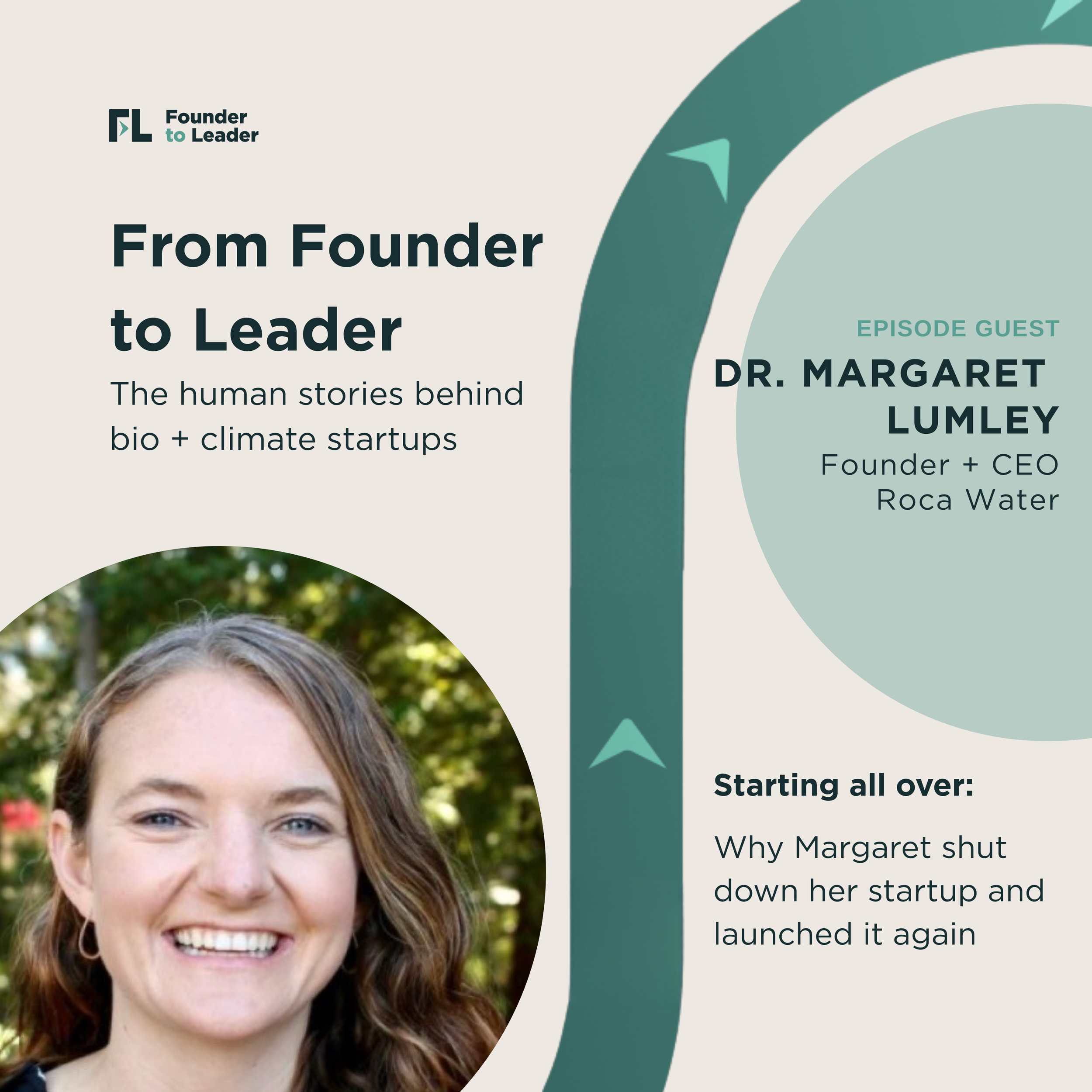
Dr. Margaret Lumley, CEO + Founder, Roca Water
Jaye Goldstein:
Welcome to another episode of From Founder to Leader: The Human Stories Behind Bio and Climate Tech Startups.
Today’s guest is Margaret Lumley, CEO and founder of Roca Water. The theme of today’s episode is starting all over—when Margaret shut down her startup and built it again from scratch.
Thank you so much for joining us, Margaret.
Margaret Lumley:
Thank you so much for having me, Jaye. It’s so fun to be here, and I’m really glad you’re doing this podcast.
Jaye:
Let’s start with your background. Can you tell us a little about your education and any work experience you had before starting Roca?
Margaret:
I grew up in the Bay Area and went to college at UC Santa Barbara, where I studied chemistry. Kind of by happenstance, I joined a battery research lab as an undergrad and really fell in love with electrochemistry and energy research.
I ultimately decided to do my PhD in chemistry at the University of Wisconsin–Madison. I moved from Santa Barbara to Madison and joined a research group that used electrochemistry to solve environmental problems. One of those projects focused on water desalination, which was really near and dear to my heart growing up in drought‑prone California.
I finished my PhD in 2020, and right after that I started a company. I had no other work experience besides being a grad student and a startup founder.
Jaye:
You were also an Activate Fellow, right?
Margaret:
Yes. The Activate Fellowship is a two‑year program for climate‑tech and biotech startup founders. It was incredibly transformative. It teaches you everything you need to know about starting a company when you come from an academic or non‑entrepreneurial background.
They focus heavily on training you as a person—helping you figure out what kind of leader you want to be and what kind of startup you want to build. I’m still really close with my Activate network.
One really important piece is funding. Activate was actually our second source of funding. I officially left UW–Madison and went full‑time on the startup in February 2022. I became an Activate Fellow in June 2022, and they paid my salary through a stipend for two years.
That’s one of the hardest parts of transitioning from grad student to founder: figuring out how to pay yourself. A lot of early funding comes from grants, but Activate is another great option. They also provide R&D funding and connect you with investors.
Jaye:
Let’s talk about your first startup, Globus. Early on, did you identify as a founder or entrepreneur?
Margaret:
A lot of founders say yes immediately—they had lemonade stands, business ideas as kids. I did some of that, but my dad actually had a wind energy startup called Heirloom Energy. I saw firsthand how hard that journey was and how long it takes to turn an idea into a real commercial innovation.
Because of that, I initially thought I didn’t want to start a company. In grad school, I loved hands‑on science, but I became interested in bigger‑picture roles—IP law, consulting, things that took me out of the lab.
Entrepreneurship came up as an option, especially starting a company based on PhD research. UW–Madison has a strong innovation ecosystem, so I did some customer discovery programs and talked with other grad students who had started companies.
I also did an entrepreneurial bootcamp through the business school—a one‑week MBA‑style crash course for science PhDs. The more I learned, the more I realized it was a great fit: staying close to the science while focusing on real‑world impact, customers, and investors.
I got serious about it around my fourth or final year of grad school.
Jaye:
Tell me about the early days of Chlobus.
Margaret:
Often, this process starts with a PhD advisor. One research idea shows promise, and you start talking about forming a company to develop it outside the university.
In my case, my advisor was still my boss—I hadn’t defended my PhD yet. When we started the company, we were navigating a tricky power dynamic: going from boss–employee to business partners.
There aren’t clear rules in universities about equity splits, roles, or valuing academic research versus future development work. Equity ownership became a big challenge for us.
Initially, we applied for grant funding—an NSF SBIR grant—which allowed me to go full‑time as founder and CEO. A big part of the transition was figuring out how the technology could actually be used in the real world and where it had the strongest market fit.
Our founding team was me, my PhD advisor, and a postdoc from the lab. Once we got funding, we hired a full‑time employee. My co‑founders stayed at UW–Madison and advised primarily on the science.
Jaye:
When did you realize the structure wasn’t working?
Margaret:
I officially started full‑time in February 2022. A few months later, I joined Activate, which provides intensive training on all aspects of running a startup—including equity.
A common guideline is that if a professor isn’t working full‑time at the company, they typically own no more than 10%. In our case, we had done an even split among three founders, which was far above that.
By that point, we were about nine months into working together. Financially, things were good—we had an NSF Phase I SBIR (~$250k), Activate support, and about $200k in investment.
When I raised the equity conversation, things started to fall apart. Asking to reallocate equity after the fact is very different from deciding it upfront. We tried to make it work, but we couldn’t find an outcome we were both happy with.
In April 2023, we decided to separate. The trust required to work together had fractured, and it was hard to repair.
Jaye:
How was your mental health during that time?
Margaret:
It was really hard—divorce is the best analogy. I had incredible support from my Activate mentor, Hannah. Without her, I couldn’t have navigated it.
We ultimately shut down the company. We had investors, grant funding, and an employee—it was incredibly heavy. I underestimated how draining the experience was. I wasn’t sleeping well, had less energy, and felt unlike myself.
Recovery took longer than I expected.
Jaye:
What made you want to start over instead of walking away?
Margaret:
We were waiting to hear back on a $1M NSF Phase II SBIR grant when we shut down. I felt like I hadn’t given it my best shot—the technology worked, we hadn’t run out of money, and the drive was still there.
I was able to transfer the grant from Chlobis to my new company, Roca Water, with a sub‑award to my advisor’s lab. That process took from July 2023 to April 2024, but it worked—and that was huge.
I also moved from Madison back to the Bay Area during this time and thought deeply about where I wanted to build the company.
Jaye:
Tell us what Roca Water is up to now.
Margaret:
Roca is developing technology to recover nutrients from wastewater and turn them into fertilizer. We’re focused on circularity and water remediation.
We’re a team of four—scientists and engineers. We’ve moved from synthetic samples to real wastewater testing, which is a big step toward pilot projects.
We’re mostly grant‑funded right now but plan to raise a seed round soon to support our first pilot in the next 18 months.
Jaye:
One final question: what’s one thing you wish you knew earlier?
Margaret:
Remember that you always have a choice. You can leave situations that don’t feel right.
I’d also add: trust your gut - especially about people and relationships. Paying attention to how decisions feel in your body has been incredibly powerful for me.
Jaye:
Thank you, Margaret. It’s incredible to hear about your perseverance and growth - from scientist to founder to leader.