Go big or go home, with Dr.Cinzia Silvestri
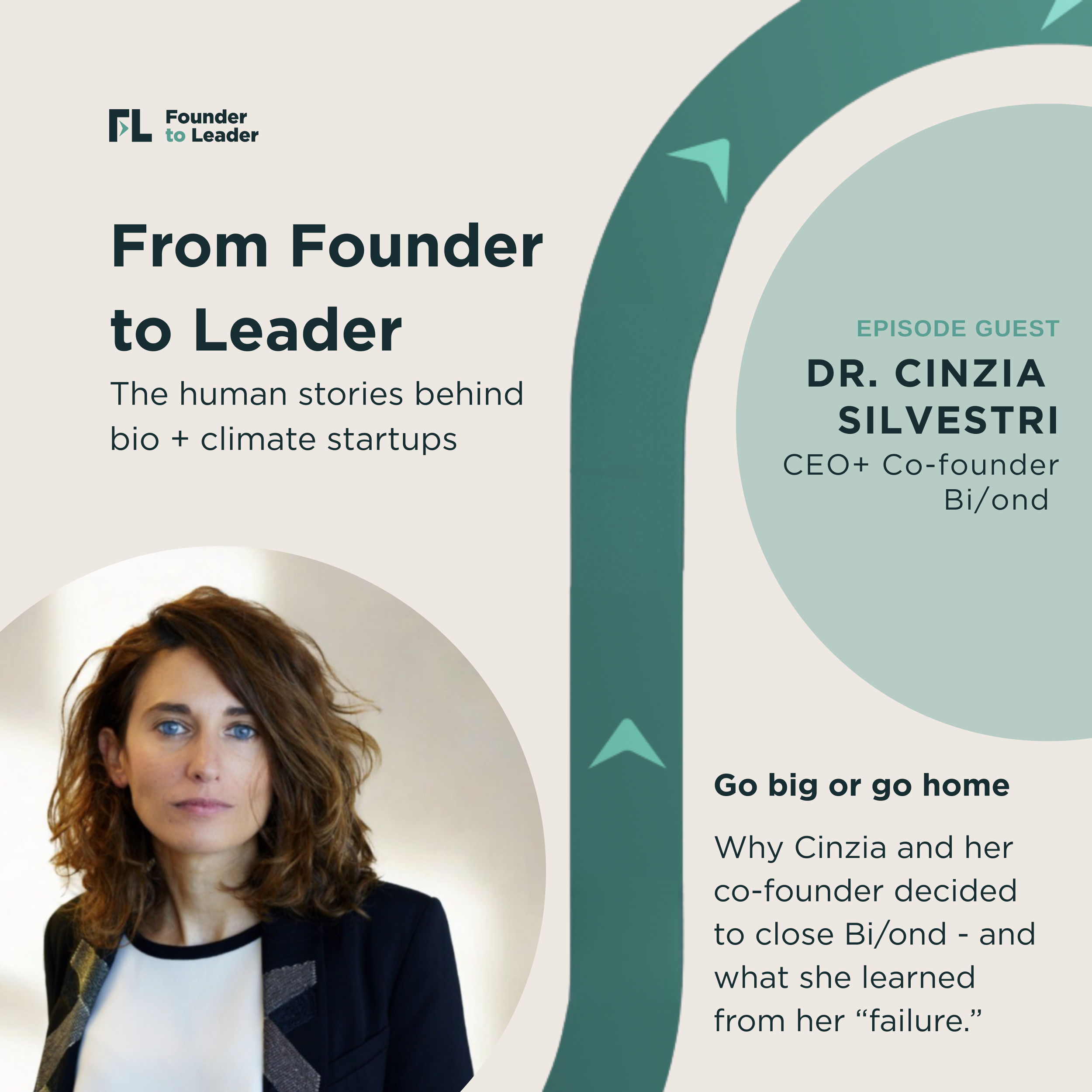
Dr. Cinzia Silvestri, former CEO + Co-founder, Bi/ond
Podcast: From Founder to Leader
Host: Jaye Goldstein
Guest: Cinzia Silvestri, Co‑founder & former CEO, Bi/ond
Jaye: Welcome to another episode of From Founder to Leader: The Human Stories Behind Bio and Climate Tech Startups.
In today’s episode, we’re chatting with Cinzia Silvestri, former CEO and co‑founder of Bi/ond. The theme today is really “go big or go home.”
Cinzia, thank you so much for joining.
Cinzia: Thank you so much for inviting me.
Jaye: Tell us a little bit about your educational background and any work experience you had before launching Bi/ond.
Cinzia: I have a bit of a weird background. In high school, I studied languages. I clearly remember telling my math teacher that I wanted to study electrical engineering, and she told me, “Well, you didn’t study real math during these years.” I said, “Okay, great,” and I did it anyway—and I graduated cum laude.
Then I did my PhD in microelectronics at Delft University of Technology. I moved to the Netherlands, and I never really had a career before my PhD. During my PhD, I spun out Bi/ond directly, and that’s where my tech founder journey started.
Jaye: Why did you decide to launch a startup? What was that journey like?
Cinzia: I was almost at the end of my third year of my PhD. In the Netherlands, a PhD is four years. My two co‑founders made a mistake in the lab, and that mistake created the core technology behind Bi/ond.
They brought it to our professor, who said, “It’s amazing, but it’s a mistake—you won’t be able to repeat it.” Two weeks later, they managed to repeat the mistake, and it became reproducible for almost the next eight years of Bi/ond.
As soon as they did that, I said, “Instead of publishing, let’s patent this and start a company.”
Jaye: What core problem were you solving with this technology?
Cinzia: We were aiming to grow small human tissues using stem cells on a semiconductor chip—the kind you find in smartphones. These chips are scalable, and you can integrate electrodes and sensors to monitor the tissues.
The goal was to help pharma companies get data earlier and faster, before going into animal studies or clinical trials.
Jaye: Let’s talk about the earliest days of Bi/ond. Your first dollars, your decision to have a co‑founder—what did that look like?
Cinzia: I think I got lucky in the beginning. We were three founders, then became two, but we had been friends for a long time. We knew each other’s strengths and roles. I was more on the business side, Nicolas more on the technical side.
Our first funding came from a grant through the university, together with another university in the Netherlands, to validate the chip. We received around €50,000, which helped us generate initial data and see that the idea might actually work.
Jaye: From there, how much did you raise, how big did the team get, and you also became a Termeer Fellow?
Cinzia: We raised around €3 million in equity and more than €3 million in grants. As a PhD, you’re good at writing grants, so that was the best way to survive before having enough proof for equity funding.
I never felt that Bi/ond was just a Dutch startup. I’m Italian, and I always felt European at least—and global. I tried to connect internationally as much as possible.
During COVID, I followed your Management 101 course to connect with people in the US, and I also became a Termeer Fellow, which connects first‑time European CEOs with the US ecosystem. That exposure is incredibly powerful.
Jaye: Before your final fundraising effort, how big was the team?
Cinzia: We were 12 people from seven different nationalities, spanning biology, engineering, and commercial roles. Very multicultural.
Jaye: You went out to raise a big round. Walk us through what happened as you began to question the future of Bi/ond.
Cinzia: It was a slow realization. In 2023, we started raising our Series A—€10 million. That was the minimum we needed, not an excessive amount. But the biotech market was very tough.
Our entire research field struggled with pharma adoption, regulatory challenges, timelines, and expectations. AI also shifted attention away from hardware. Funding in both Europe and the US was very difficult for biotech.
We had about €7 million committed—roughly 70% of the round—but we needed a knowledgeable lead investor, someone who had built a similar business and could be a real sparring partner. That was missing from our cap table.
When the last investor I really believed in declined, that was a major blow.
We had new customers coming in, but revenues—around €300,000—weren’t enough for investors. Many customers were rare‑disease focused and struggling themselves.
I asked myself: how could I look these customers in the eye, sell them something in January, and then reduce funding or close the company in June? That didn’t feel ethical.
I also looked at the team. Some had been with us for five years—brilliant people in the prime of their careers. If my vision was cracking, I felt dishonest motivating them.
Many were non‑European, with visa considerations, and the job market wasn’t strong. So I decided to pull the plug early, while we could still protect them.
Jaye: How much runway did you have at that point?
Cinzia: We had runway until the end of June—about six months. But I wanted to end early to give everyone a parachute and avoid onboarding new customers without a clear future.
I still held the majority of the company. Putting my pride aside, I wanted to end things gracefully, even though it was incredibly hard after eight years.
Jaye: Who was most helpful during that decision‑making process?
Cinzia: First, my co‑founder Nicolas—we were aligned from start to finish. I also talked with close friends and family, even though they’re not entrepreneurs, to understand whether closing meant failure.
I spoke with other CEOs who had failed—European and US—to learn how they survived it. And I spoke with you as well.
It was about understanding where the line was between resilience and pride.
Jaye: Do you consider this a failure?
Cinzia: Yes. I think we need to normalize that word. Psychologically, you need to digest failure. This is the biggest failure of my career so far.
I had merged my identity with the company, so failing Bi/ond felt like failing myself. But it didn’t work out the way we planned, despite the effort.
There were market and macro factors, but there’s never just one reason. It’s always a perfect storm.
I made mistakes too: not onboarding the right investor early enough, not preparing alternative paths like M&A sooner, and not complementing myself with a more assertive co‑leader earlier.
Jaye: How was your mental health through all of this?
Cinzia: Not great. I’m ambitious, and with ambition comes pride. I put everything into Bi/ond for seven years. It was hard to accept the end.
I relied on my engineering mindset—analyzing data so I wouldn’t regret the decision later. I also went to therapy. This was a major life transition, and I wanted to learn from it.
Even now, I sometimes have to re‑digest the decision. I miss the company. But learning about myself has been crucial.
Jaye: What are you most proud of from your Bi/ond experience?
Cinzia: Building the team—seeing people believe in the vision.
Also, opening our biological lab as a group of engineers nobody expected to succeed. That felt like conquering new ground.
And selling to a big pharma company—seeing our idea in their hands.
Jaye: What’s next for you?
Cinzia: I’m running my biggest biological experiment so far—I’m pregnant. This time there will be a real delivery.
Professionally, I’m taking time for myself. I’m doing early‑stage due diligence with angel investors and exploring. I don’t know yet what’s next, but it will involve innovation and meaning.
I may not be a CEO for a while. I want to observe others leading and learn from that.
Jaye: As we wrap up, what advice would you give our listeners?
Cinzia: Be persistent—but make sure you’re progressing, not just surviving. Your time matters.
Know your limits, accept them, and find people who complement you.
And build a network of founders where you can be brutally honest. Being a CEO is lonely, and knowing you’re not alone matters.
Jaye: Cinzia, thank you for your honesty and vulnerability. You handled an impossibly hard decision with grace and humanity.