Leveraging AI for Startup Operations
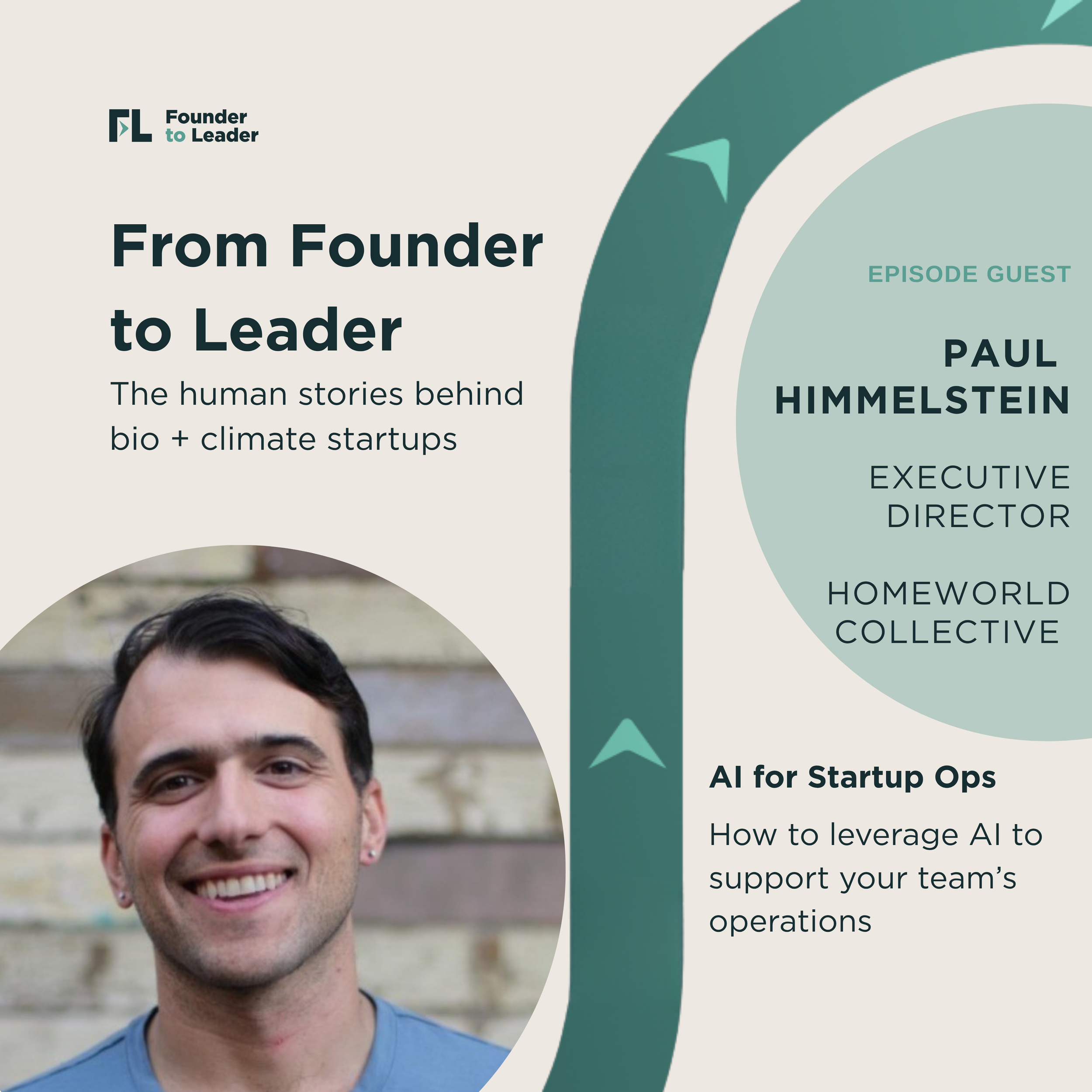
JAYE: Welcome to another episode of From Founder to Leader: the human stories behind bio and climate tech startups. In this podcast episode, we are demystifying what it looks like to build a hard tech startup from the ground up by sharing the real human stories behind the headlines from the people driving innovation. In today's episode, we're going to be talking with Paul Himmelstein, Executive Director of Homeworld Collective, a nonprofit organization that's bringing the best of biotech to planetary health. Homeworld Collective is dedicated to nurturing the growth of climate biotech by fostering community, building knowledge, and directly supporting early-stage research. Now, in full disclosure, Paul is a client of mine, and I asked him to come on today because he is an extraordinary uber user of AI, helping his tiny team, which currently has, I think, three full-time members, punch far above its weight. So, Paul, thank you so much for joining us today.
PAUL: Yeah, it's great to be here, Jaye. Thanks for having me.
JAYE: Absolutely. So let's start first with your story, which is: how did you end up at Homeworld Collective?
PAUL: So I have a circuitous journey toward Homeworld Collective. My background is in international development, nonprofit fundraising and management, political organizing, and education for the last, I'd say, 10 or 15 years before I came to Homeworld. And I joined Homeworld because I wanted to throw my shoulder behind how the science fiction future that's coming very rapidly can be used for good. I'm really excited about the promise of biology and biotechnology for the solutions that our world needs. And after some exploring and learning and networking, I landed on Homeworld.
JAYE: I love that, and the world needs more of your skillset in this space. I love that you bring community organizing and political change to this role. So you have a really tiny team, and I'd love for you to talk about how you got into using AI and some of the successes you've had figuring out when and how to leverage it so that you can really be a bigger team.
PAUL: Absolutely. Before I jump into that, I do need to give a big nod of acknowledgment to Homeworld co-founders Daniel Goodwin and Paul Reginato, who incubated Homeworld starting in 2019, going into 2022, and co-led the organization for a number of years until recently. So the velocity that we have is inextricably tied to their vision and momentum and leadership. And yes, we're accomplishing a lot with a tiny team. Even when Dan was ED, we were accomplishing a lot with a tiny team. But I definitely need to give them a shout-out for context.
JAYE: I love that you gave that nod. And I also want you to quickly explain to the audience what the things are that you do, so they have the context of the complexity of the organization as a collective.
PAUL: Absolutely. So we are a nonprofit helping to build the field of climate biotechnology. That's biotechnology for solutions in climate and environment, planetary health. When we were founded—again, when Paul and Dan founded the organization—they saw three interrelated problems in why biotech was underperforming relative to its potential. There was a lack of community infrastructure. There was a lack of knowledge resources on how to plug into the solution space. And there was insufficient funding specifically for the risky research that predicates tomorrow's big ideas. And so they set out—through some incredible thought leadership that I highly recommend everybody goes and reads—to create the community, knowledge, and funding resources necessary to unlock the potential of biotech. And so we do that through community building; creating roadmaps and white papers and publishing problem statements for technical opportunities to further invest in research-wise; and directly supporting and driving funding and other resources toward research teams working on the bottlenecks to progress.
JAYE: So you give out grants?
PAUL: We do. And there's a lot of operational work that goes behind the grantmaking process, for sure.
JAYE: Yeah, absolutely.
PAUL: It's an operationally heavy lift, with a lot of scientific leadership.
JAYE: And you have a podcast, and you have a lot of things coming out of your small team.
PAUL: It's super true. So, to your question: how did I get started using AI?
JAYE: Yeah. What was your entry into using it?
PAUL: So I mentioned my background, and I alluded to the career pivot that brought me to climate technology work and Homeworld specifically. When that career pivot happened was right when GPT-3 and 3.5 came out. And so I found myself with a scrappy, successful background as a generalist, essentially, in the nonprofit space, in a new domain with new language and new infrastructure and new players. And having AI as a partner—I'm showing some cards right now, but I'll say this anywhere I go—really helped me fill in the gaps of my expertise and experience. The number of times that you really need to run an idea by someone, and you're like, "Wait, can you hop on the phone with me for 30 minutes and talk to me about contract law? Project management?" Anything. Just the ability to quickly get to the point where gaps in knowledge were not a liability was the first main use I had, in, what, February of 2023?
JAYE: Yeah. I mean, that's the early days, the beginning of early innovation adoption. So that's back then, which is, what, three and a half years ago? And since then, you have really been an uber user, figuring out how to create agents and parallel workflows. Tell me what you do.
PAUL: What's interesting about AI from, in this case, an operations perspective is that it's constantly changing. On the one hand, you have people who, like my early example here, just use it to fill in knowledge gaps, or to skip the line and save time reading through advertising-heavy articles in an increasingly fraught Google algorithm. And then on the complete other end, you have people who have wired up multiple servers or personal computers with multiple Claude and ChatGPT instances, and maybe their own locally hosted AI model, to have a vast team cycling loops on creating these incredible resources from scratch. So I just want to name that there's a massive spectrum of using AI. I find myself squarely in the middle there.
And so the way that I work currently—or the journey; I'm going to talk a little bit about the journey over the last few years, because I think that helps people understand. There's this concept of the jagged frontier. I think Ethan Mollick may have coined it, and it's the fact that AI is constantly changing, and the frontier of what is available is constantly changing. And that bumps up against the frontier of what you know how to do and what you need to do, and your understanding of how your own context relates to the skills and availabilities of an ever-shifting AI landscape. And so part of working with AI is just doing it. Sometimes there are inefficiencies to it, and sometimes there are great efficiencies to it.
So one of the first major wins that we had was when we were building our grantmaking platform: generating and integrating many different Excel formulas into a robust 12-tab pipeline that had a team of 70 reviewers and 100 applicants and multiple IP-sensitive links to external platforms. It was very complicated. But AI has the ability to quickly solve for the things that you wish you could do. "Oh, I wish that I could do this," and it'll tell you how to do it. "Wow, that's an incredible Google Sheets formula. How wonderful." That's an example, and that was two years ago, and so much has changed since then.
JAYE: What's an example of how you—so you had this giant spreadsheet with 12 tabs. What was something that you wanted to do but couldn't figure out how to do?
PAUL: I wanted to generate a list from a group of 70 reviewers. And this is me—I'm not a software engineer, so this conversation will land differently if you have a deep coding background. I wanted a list of 70 reviewers, who had all self-identified their different technical expertise areas, to be populated in another tab when we tagged an application as needing review in a particular technical expertise area. So the ability for us to say, "Oh, hey, enzyme engineering. Great. Filter the list of 70 reviewers for people who have that expertise, and then create a dropdown that can quickly get them to it." It just saves a lot of clicking-back-and-forth time. It's like, "I really wish we could do this."
And AI is sort of like—if you're an outdoor sports person, backpacking gear over the last 20 years has actually gotten much more dialed in. It's like everything you might need—"I really wish this strap was here"—you reach for it, and lo and behold, it's there. It's knowing to reach for that strap. AI can help you cover the gap of the things that you wish you had. Maybe that's a little too meta for this conversation.
JAYE: No, no, that's exactly it. That's exactly the level of "I have no idea, but I'm going to start to approximate the thing that I wish."
PAUL: But these days—and I think we can just skip the line a little on what the journey has been—even with Opus 5.5 on Claude coming out in the last week, as of this recording, it's once again different. A lot of people are on, what, the $20-a-month plan? Although we have the $100-a-month plan. There's just been a step change in what you need for your daily use case. Mistakes are just—I've been saying this for a year and a half, and it's why I keep saying it—but mistakes are even less frequent. Hallucinations are almost gone entirely. The ability to cross T's and dot I's is fast.
I mean, we can just get into specifics here. I'm just going to tell you some specific things I've done in the last few months. I had a teammate leave who was deep in our operations. She did an incredible job, and we were in a time of transition, and I didn't have the ability to bring someone on for, I think, four to five months. I took—I think it was Claude Fable 5 at the time—the 20-page onboarding document she made explaining her role. I took it, wired it up to her email history and the SOPs, the standard operating procedures that we have in Notion, and I told Claude to create as many automated workflows as were possible given that. And now I have about eight daily triggers that scan my inbox for extension requests on funding from our grants and automatically draft responses if there's insufficient information for what we need from them. Then, when that information is presented, it will automatically draft up a contract and send it through PandaDoc to the point of contact they listed. And the only thing I need to do is go into my drafts once a day during my inbox time, review that content, and hit send. I do not let automatic sending happen through AI. Absolutely not. So that is nuts unto itself.
Another one is invoice forwarding. Invoices need to go through me to our finance team, and it will do a daily scan of people who send invoices. Then the automated effort is to create a draft forwarding it to our nonprofit controller at a firm, saying what the class and category for the QuickBooks coding should be, because it's wired up to our list of expense classes. And then I review that, and then I send it.
JAYE: Wow.
PAUL: There's a weekly or semi-weekly trigger to catch anything that I missed from our Slack and email and send me a digest of open loops that I have not closed yet. Those are some baseline examples of "Oh, what do I do when my operations team left?" And I will say it's definitely not "Oh, you just do it once and you forget it." Managing AI is work unto itself, and it's a different kind of work.
I sort of think about AI right now as, first, this initial example of helping you skip the line on gaps in your knowledge or expertise. And then there's the quicker ability to generate tools. At this point, instead of asking for bespoke—if I can use the word "bespoke"—Google Sheets or Excel formulas, now you can just ask for the thing, and it will whip up a multi-tab, perfectly integrated sheet with all of the formulas dialed in, with data validation and color coding. It's wild. My challenge to listeners would be: What do you wish it could do? Just ask and see if it can happen at this point.
Some other things that I have done: we use Folk CRM as a funder pipeline and as a partnership pipeline. I wired up Claude to email, Slack, et cetera, and created the CRM of all of our potential partners with all the contacts from all of our conversations. And then when new emails happen, they just get loaded into the context of the CRM.
And so I think the biggest power—I don't use ChatGPT for work, not for any other reason except that I started in Claude and stayed in Claude. But I will say that the true power that I have found, and this is with Claude Cowork, is through the connectors. How many different platforms do you wish you had an excellent project manager or a strong coordinator to comb through? Right now, connectors I have, off the top of my head, are Gmail and, relatedly, Superhuman—I recommend people get Superhuman. Thanks, Jaye, actually, for the push to get Superhuman—Notion; there's now Google Sheets and Google Docs as connectors; Folk CRM; Miro; Fathom, the AI notetaker. The list goes on. I have about 30 of them. And if you use it enough, you get to the point where you just take buckets of information that you know you would work through with enough time and energy or team, and then, with a prompt, smash them together and see what happens. That's what it feels like, honestly. It's crazy. I think the best example is the workflow example that I mentioned earlier about the SOPs and the email history.
JAYE: I want us to talk a little bit about how you and I have been using it around strategic planning.
PAUL: Yeah.
JAYE: Because I do think this is also—it's not just an operations workflow; we were also able to synthesize lots of information, lots of conversations. And what I loved about what you told me in a recent conversation was that we had an older version of a strategic plan. Tell the story about how you asked Claude to compare what was different between the versions.
PAUL: So we have an eight-month-old strategic plan that was excellent. And our direction after the leadership transition has changed a bit. We ran a big community survey, and we are sharpening our attack in some areas and softening in other areas. The robust 11-page document was nuanced. And between that draft and when I needed to update it, we had generated a new pitch deck, and I had presented that pitch deck a number of times. This pitch deck was the result of this new strategic direction and new initiatives. And I looked at the strategic plan and I thought, "Wow, it's going to take me a long time to clean this up." So I took one pass through it to re-familiarize myself with it and make the changes that I wanted to do manually. Then I asked Claude to take the strategic plan—also, my Claude has so much context on Homeworld now. I don't need to remind it of everything; it just has a history and story. It's incredible context that it has managed to build just from my using it over the last six months. And I said, "Please take the transcripts from the five times I've presented this deck to external partners and create one clean script from them. Also, take this deck that I made, go through the strategic plan, and note all the ways in which it is inconsistent with what I have currently developed." And that is interesting. But what's incredible from there is that now, with this new Google Docs connector, which is only a few weeks old, it was able to go into the actual document directly. And I said, "Only make suggested changes. Don't make hard edits. And in comments, add any place in which there's a discrepancy, along with your suggestions." These suggestions are not always right. But when you're writing, it is so nice to have something to react to. And so I just got to go through this 11-page document and see literally 40 comments and multiple suggested edits. That would have taken me forever, and it only took me a few hours.
I think there is, in this—we're going to get to the big mistakes eventually, right? The ways in which AI will...
JAYE: Yeah.
PAUL: Okay, cool.
JAYE: Great, great, great.
PAUL: Should I just move into that? Okay, cool. There is an incredibly dark side to AI. I'm not even talking about the AI doom, human-extinction stuff that's in the news right now. I'm talking about your brain, my brain, and its relationship to using artificial intelligence for daily activities. There are a number of dark sides that I've found in AI. One, if we're talking about the strategic plan: AI is horrible at writing things from scratch when you're at the level of strategic thinking and thought leadership and truly creating something. There's a line I heard recently, which is: AI is trained on the past, so how can you create the future if you're calling from the past? As it currently stands, even in this moment of AI, human cognition—your brain—is the creator of the future. And the past context is what you can call upon with AI to help weave it together and cover your bases as you're moving forward. But writing a strategic document cold, it's going to mess you up.
Additionally, if you're trying to create important written material that's AI-generated from the robust context of your background or your organization's history, you're going to get a three- or four-page document that is just right enough that it feels like it should be right, and then it's just wrong enough that it'll be super exhausting. And something I've noticed is that if you're reading your own AI-generated content at the strategic level, it's really easy for your brain to turn off and stop addressing it properly and just take it as true when it's actually wrong. It's this uncanny valley moment where it's almost what you would say, but it's not quite. And you're going to send it to somebody else and they're going to know it. People know. There's this BS detector that's getting stronger and stronger for everybody, where you can read an AI-generated email, you can read AI-generated social copy, and people are just blanking out. And so there's a very dark side to surrendering your own effort and process and strategic thinking to AI. I think we're going to see a huge whiplash from it.
So in all these things, notably, the stories that I told that were successful are all grounded in successful human effort, with AI then helping you skip the line on what it would take to process that through a rinse-and-repeat process and get a result. And so I think AI, in a nutshell, is: you have to make the SOPs yourself. AI can't make the SOP. If you have AI make the SOP, you're going to read it, it's going to feel almost right, but then something's going to break later. You need to develop that yourself, and then it can execute on it.
So that's one big issue that I've had. Another—I mean, I have so many hilarious bad stories of times that I misused AI and sent bad copy to my manager. Thanks, Dan, for your patience. Or this one time when I was supposed to take notes for a meeting and ran it through an old Whisper model instead, and it just dropped the ball, and I lost a high-leverage meeting because I didn't take personal notes. There are just a lot of ways in which you cannot surrender your human effort. I even had a few months this year when I was like, "Wow, I wired up Fathom to transcribe all of our meetings. I don't need to take notes again. It's all going to be in my Google Drive." And it is all in there. But it's not actionable. My brain forgot them. I don't have the reminder of the context in the notes documents and the meeting agendas. There is something fundamentally important about doing things yourself so that your brain holds on to them. There are more and more studies coming out right now, but already there's cognitive decline and parts of our neurology shutting off with AI, and you will feel that in the moment.
JAYE: So I want to start bringing us to the finish line here by talking a little bit about the fact that, on the one hand, you've found a way, from an operations perspective, to automate a lot of things that are very rote and take a lot of your team's time, taking them off your plate, with human supervision. Right? And you've found a way to have it speed up your strategic planning process, but not write your strategic plan. Right? And in many ways, you've saved an enormous amount of time and money by experimenting, asking AI to try to solve problems you're struggling to figure out, and evaluating along the way whether it's in fact helping you achieve your goals or not. As we start wrapping up, what would be your number one piece of advice for folks thinking about how to leverage AI in their own teams—scrappy small startup teams, operations?
PAUL: I would say: What do you wish you had someone to do? And then just throw in a prompt like, "Can you do this?" Examples of that could include: "Who are all the people I've emailed in the last two years who could advise on this topic?" You could go do that manually, or you could ask Claude Cowork with Opus 5.5 to quickly make you a list.
I had an interesting moment where, retroactively, I had to classify two restricted grants totaling about $500,000—$250K each—across a fiscal year. And I was like, "Claude, here's my list of 3,000 itemized transactions across payroll and expenses. I need these split equally 50/50, totaling up to $500K." And it just went through 3,000 lines and assigned each one to a restricted grant. And not just saying what it was, but with formulas that I could check, like, "Oh wow, this sort of formula is accurate." I put in three years of our financial transactions and found out we hadn't paid someone their second installment of $3,000 from a year ago. That's a fun one.
So I'd say: if you could do something with enough time, or if someone on your team could do something like this with enough time, but it would take a lot of time—wouldn't it be nice if someone would do that? That's an excellent use of AI. The thing that I would warn about ahead of time is that, like developing any new skill or new tool, there are going to be a lot of things that feel inefficient. You can spend an hour figuring out how to make an email draft automated when it would have taken you 30 minutes to just do the emails. So there's an inefficiency up front to doing it. And then there's an inefficiency that sometimes doesn't bear fruit: "Oh, it turns out that this is actually just a bad thing for AI." And only you will be able to discover that, because of, again, that frontier. The advice from a few years ago—Ethan Mollick's stance—is: try to use it for everything, and then you will learn how it works for you.
JAYE: I love that piece of advice. It's wonderful. And I love how much you've learned, and I'm so excited to see what is about to happen with you and Homeworld as you start to beef your team back up again and do some exciting things.
PAUL: Can I say one more thing, actually? One of the examples I used was essentially that I took part of someone's job and replaced it with AI. And it's a scary world that that is something we can just say out loud and do. I think there's a moral and ethical question there that I'm not ready to answer right now, but I think the fear that people have is justified and real. And so, as we're simultaneously saying, "Oh, power user of this stuff, stringing things together," I don't think we should lose sight of the big questions and the impact that this is having.
Additionally, I have also explicitly carved out space in my life where I refuse to use AI. I have an art community and artistic practice set aside, and I'm working on an art project right now with some collaborators to make a theater piece, and I absolutely refuse to use AI. There's no AI notetaker; there's no AI synthesizing of ideas. I might DM a Dungeons & Dragons campaign next year, and despite how much information there is to digest, I absolutely refuse to have AI be in certain parts of my life. And I would recommend that to everyone as well. I think it's going to be a bigger and bigger question: Where do we assume that humans have an exclusive domain on things? Or where do you want to have an exclusive domain over your thought and your process? That's an open question for everybody to answer for themselves.
JAYE: I love that. There's also the environmental impact of using it, which, as a climate org, you probably think about all the time. There's a lot of complexity to this. That being said, as a scrappy small startup, it's hard not to think about how you can leverage some automation and some incredibly robust data scouring and all the things it does to help your team be effective and efficient. So, Paul, thank you so much for sharing all of your insights and for spending your time with me.
PAUL: Thank you so much for having me, Jaye.