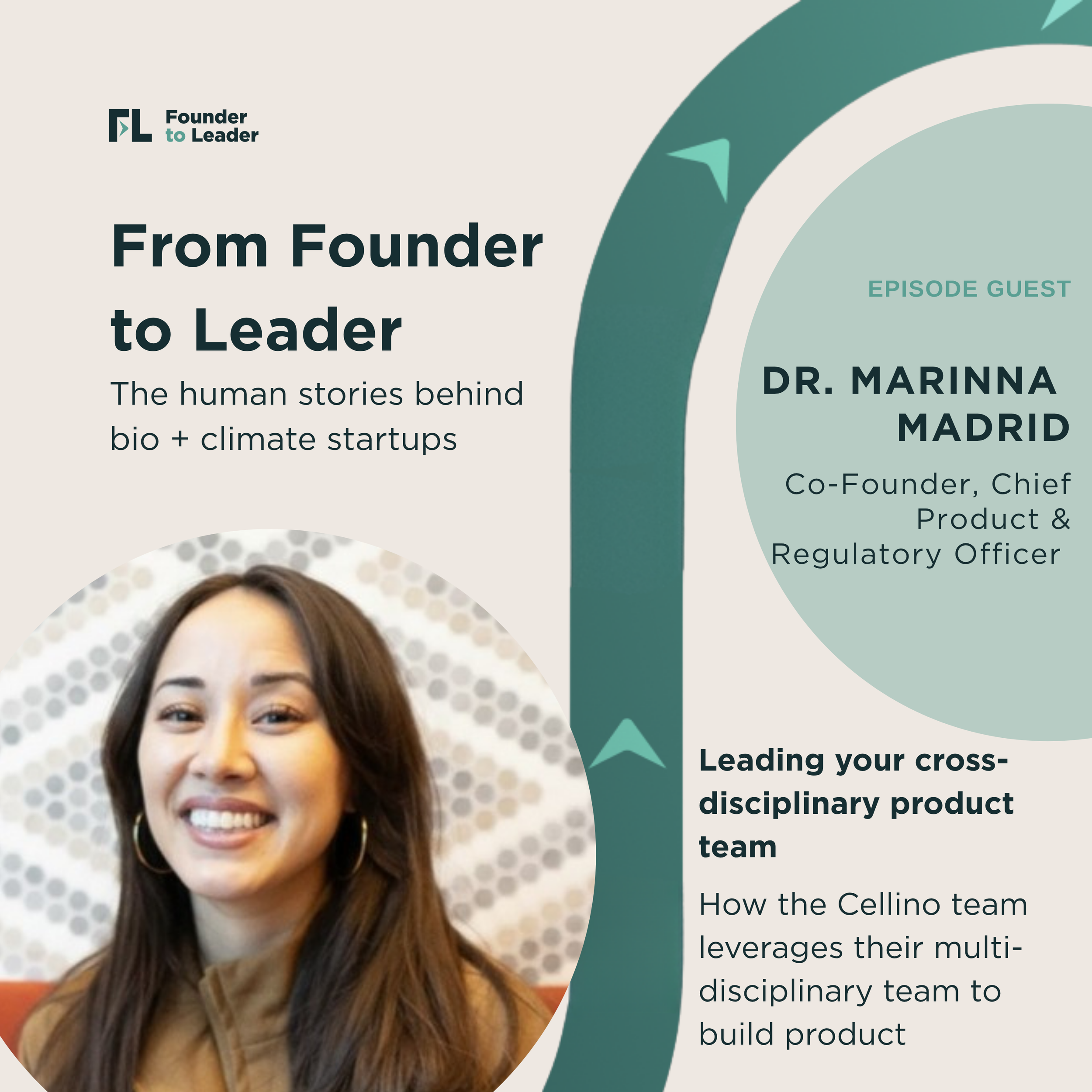
Dr. Marinna Madrid, Co-founder, Chief Product & Regulatory Officer, Cellino Bio
Welcome to another episode of From Founder to Leader: The Human Stories Behind Bio and Climate Tech Startups. In this podcast episode, we are demystifying what it looks like to build a hard tech startup from the ground up by sharing the real human stories behind the headlines from the people driving innovation. In today's episode, we're going to sit down with Dr. Marinna Madrid, who is the Chief Product Officer and also the Regulatory Officer and co-founder of Cellino Bio. We are so thrilled to have you here, Marinna.
Marinna Madrid: Thank you. Super happy to be here.
Jaye: So let's get started with just your journey to entrepreneurship. When did it become obvious to you that this was a path that you wanted to take?
Marinna: Basically, not until I took it. So the story of my career—I'll start from the very beginning. When I first graduated high school, I went to NYU to study journalism, and it ended up being a terrible fit. I hated it. I dropped out in the middle of my first year. I moved back home to California and started over at community college, and that was really where I fell in love with science, especially physics and biology as well. And so I ended up transferring to UCLA to do a degree, a bachelor's degree in physics.
And so at that point, what I really wanted to do was to become a community college teacher, because community college had had a really big impact on me, and I just loved the environment there. It's very diverse. The teachers—the professors—are 100% focused on teaching. It was just so supportive. And to teach community college, you don't need a PhD, you just need a master's. But master's degrees cost money and PhD degrees don't. So my plan was to get into PhD programs and then master out with a free master's, which is not what I told people when I was applying, but that was actually my plan.
And I ended up getting into Harvard. And so I entered the Harvard PhD in Applied Physics program, basically with this plan in mind, planning to master out at some point and teach community college full time. But while I was there, I kind of fell in love with this project that my labmate, Nabiha Saklayen, was working on, essentially using lasers to manipulate cells. So at the time, she was using lasers to poke holes in cell membranes to be able to deliver cargo into cells. And so I started working on this project, really loved it. We had a great working relationship.
At some point, this caused me to stay in the PhD program longer than I had originally intended anyways. But at some point she asked me if we should do a startup, and it's not something that I think she or I had ever considered as a career path before. I wanted to teach. I think she would have probably gone on to do a postdoc and work at a bigger company. But we had been collaborating with some biologists at Harvard, and some of the professors there are highly entrepreneurial—George Church, Derrick Rossi. This was also—he's the founder of Moderna, but he was at Harvard at the time, and these professors had actually encouraged us to commercialize the technology. And it's not something we had ever done before.
But when she proposed it, I was kind of like, "Well, let's just try it. If we hate it, we can quit after a year." It felt really low stakes and there's just been a ton of momentum. So that was back in—we incorporated in 2017, so it's been almost a decade now and we're still in it. And I think this is what we're going to be doing for the rest of our lives.
Jaye: I love that story and I love that you have teacher roots, much like me.
Marinna: Yeah.
Jaye: Okay, so you are Chief Product Officer, and you have been so in the various stages of growth. I'm curious to hear how you think about this role and what are some of the key criteria that you've learned that help you drive product and really produce results as a team?
Marinna: I think it's a really interesting question to ask, especially coming out of a PhD lab. So a lot of startups come from a PhD technology, and it's almost like a backwards way to do a startup. Like the correct—and I'm using air quotes, even though people can't see—the correct way to do it would be to identify a problem and then figure out what is the best solution to that problem, whether it's a product or a service.
But when you're spinning out, when you're developing a startup that's kind of based on a PhD technology, you kind of have a solution that you think is a solution to a problem, but you don't understand the problem really well. You understand the problem at the level of a PhD student, which is to say you haven't really done any market research, and then you're doing the startup and you're trying to backfit the solution to the right problem.
So it actually took us a couple of years at Cellino before we even really decided what cell type we were working on, and what that required was a very, very deep understanding of the industry. So my PhD was in physics. I'm at the point now where when I get invited to give a talk, it's at a bio conference. Basically, it took a couple of years to really develop deep expertise in biology and to be kind of respected as a leader in that space.
So I think one of the really important characteristics for someone who's leading product is to have kind of one foot in the external-facing world and then one foot in the internal-facing world. You can't get stuck. I think it's easy for PhD scientists to kind of get very attached to their technology and to fall in love with a specific application, but that might not be the right application. It might not be the application that really has a market.
So just as the very first example, when we were first developing the laser technology, we were using it to poke holes in cells to deliver cargo. We thought this was the killer application. And then we went out and talked to a bunch of folks in biotech and pharma, i.e., potential customers. And what they wanted to know is if we could use the laser to just kill cells. And it's not something we had thought about as PhD scientists, because using a laser to kill cells is a very easy problem from a laser physics perspective. It's like almost like, what? It's so easy to do from a laser physics perspective. You know, working in a regulated environment, there's more that goes into it. Whereas choosing the exact right laser energy to deliver cargo into cells, it's much more complex. So more meaty for a PhD program.
But the point is not getting too attached as a scientist to your invention or to the first application that you chose, and having enough of a presence in the external-facing world to understand what problems actually need to be solved. And then how do you fit your solution to that problem, I think is the first step towards figuring out what products actually matter.
Jaye: I love that. So just thinking back to the early days, the job looked really different than it does now. And what do you think of the big phases of the job's development and therefore your development that have allowed you to eventually become Chief Product Officer of a fairly large startup at this point?
Marinna: Yeah. I mean, I would say generally in the early days, everyone was doing everything. So I was actually in the lab testing, running laser experiments on different cell types. So the cell type we work on—I'll kind of do a little tangent to talk about our cell type. We work on induced pluripotent stem cells.
The reason why these cells are so important is because every day as you age, your cells get a little bit older and a little bit more dysfunctional. And so there are a lot of diseases that happen because your cells are either not functioning properly or they're degrading and they're degenerating and your body doesn't regenerate them. So in Parkinson's, you lose dopaminergic neurons. In diabetes, you lose beta cells. In heart failure, you lose cardiovascular cells. And so you can imagine if you could just replace these cells, regenerate these cells, and transplant them back into the patient, you could cure a lot of very important chronic degenerative diseases.
And so that's what is special about induced pluripotent stem cells. They have the code within them to become any cell in the human body. So what we're trying to do is create a world where this form of regenerative medicine, this form of regenerative health, is standard of care. Everyone can just have access to replacement cells, tissues, entire body parts on demand. Imagine you could just 3D print a new arm if you needed to. That's what we're trying to build.
It took us a good couple of years just to even decide that we wanted to work on and focus on induced pluripotent stem cells. And in those first couple of years, there was a phase where I was in the lab running laser experiments on different cell types that came up in conversations to try and figure out, does our technology even work with this cell type?
And then as the team grew, I came out of the lab. So we have a lot of very highly skilled scientists who are in the lab running experiments, and I'm not doing that at all anymore. I haven't for many years. But now we're at the phase where we are building a technology that can manufacture these cells in a scalable manner, and we're getting close to being in the clinic. So what really matters is engaging with regulatory bodies. And again, product is kind of one foot in the internal world, one foot in the external-facing world.
And so a lot of the work that I've done over the past couple of years has been to engage with different regulatory agencies. So I built a really strong relationship with the FDA, but also the EMA—so the U.S. regulatory body—the MHRA, the UK's regulatory body, the PMDA, so Japan's regulatory body as well. And those interactions help guide how we develop the technology, because we're developing the technology to manufacture therapies that are regulated.
Jaye: So your team is actually producing your product. They come from many different backgrounds, right? You have some biologists, you have some physics folks, you have some laser folks. You have people with multiple disciplines. Correct?
Marinna: Yes, absolutely. I think that's one of the most unique things about our team. So the founding team were physicists. We have kind of learned the biology on the go, but we have had folks—we have a very multidisciplinary team. So biology, laser physics, engineering, AI, that's all represented. We've had folks in AI on our team who come from the drone industry, because that's an example of an industry where they've had to look at a lot of images and do image analysis. We've had folks on our engineering team developing our fluidic cassettes for cell culture that are from the gas and oil industry, because there are some super talented fluidic dynamics engineers there.
So we have folks not just in different disciplines, but coming from super different fields. And I think that's been really important because I do—one of my personal theses is that all of the biggest, most complex problems will be solved by multidisciplinary teams. Part of the value in bringing in people from other industries is that they're not burdened by the assumptions of what's possible. When you've been in one industry for a very long time, you kind of start to soak up these assumptions about what's possible, what's too difficult. I even see it in myself now, having been in cell therapy for ten years. And folks who come from different industries just aren't burdened by that. They're more willing to try new things, which is, I think, why my co-founder and I even got into this space in the first place, because we've chosen—of all the cell therapy types we could have worked on—I think we chose the most difficult one.
Jaye: How do you functionally—I mean, let's get a little tactical here - build product. They all speak slightly different languages of science. They all have slightly—and you know, one word means one thing in one discipline, it means something very different in another discipline. And they all have different ways they've been trained, modes of operating. How do you actually get these very multidisciplinary teams to produce something effectively together?
Marinna: Okay. This is a really good question because I think this is a classic tension that can come up, especially when you're thinking about engineering and physics versus biology. Biology—the experimental timelines are so long, we don't even have a fully operational mathematical model of the cell. You can't get answers in black and white, and engineers are more like, "Why is this taking so long? Why don't we fully understand this system?"
So there are a couple of things to it, I think. I think it really starts with the hiring. There's a type of person that can work really well with experts from different fields. Everyone at Cellino probably has the most expertise in their own field and is working with people who have significantly more expertise than them in totally different fields, and that's a kind of unique working situation. And so I think one thing we really look for when we're hiring is humility and communication skills—the ability to communicate across disciplines to someone who doesn't have expertise in your discipline. It requires patience sometimes.
The other thing that I would say, you know, tactically, tactically from the perspective of structure of the team, I really don't like having disciplinary silos. So I've tried to avoid saying, "Okay, we have an engineering team and then we have a biology team and then we have an AI team." So on my own personal team at Cellino, I have engineers and biologists and bioengineers. So I think to the extent that it's possible, structuring the team so that it's based around a common goal as opposed to a specific discipline, really helps break down some of those disciplinary silos.
And more and more, we're seeing really incredible candidates that are sitting at the intersections. You know, bioengineering is a more popular degree now than it was ten years ago. So if you set up that kind of a structure where it's a really interdisciplinary team, who manages those people then? Because if you're not a content expert in their specific domain area, how can you help them?
Jaye: That's a really interesting question. So part of the way that I help them—and I do like to hire people who are more skilled or educated than me in specific domain areas, because then I feel like I can also learn from them. Part of how I'm helping them is just figuring out how to prioritize the work in the context of the company's overall goal and mission.
So the way we've structured the teams right now—and you're going to laugh at the names—but right now we have three groups. And the groups are—and I came up with these names—the groups are Seed, Sprout, and Slay. And so they're not based on discipline. They're actually based on level of scale.
So Seed is the kind of zero-to-one. These folks are inventing new things. They're showing that something can work and it's possible for the very first time. And then Sprout—this is the team that I run—Sprout I think of as one-to-ten. So we know something works and we want to find product-market fit, test it out, run it at this relatively small scale, but making sure that it's reproducible. And then Slay is how we're thinking of massive scale. You know, we're building these technologies ultimately because we want to be able to manufacture for the hundreds of thousands of patients a year. And so that's how we're thinking about that.
But you do need every single discipline represented in each of the categories. And I do think the folks running these teams, we're all multidisciplinary in our own way as well. But we do recognize that a lot of the individual contributors have more expertise than we do in specific disciplines, and that's actually something that we like and kind of look for when we're hiring.
Jaye: And if they have challenges, who do they go to for their domain expertise?
Marinna: For specific domain expertise, it really depends. So in terms of prioritizing the work, etc., making sure everything is aligned, that's definitely the team leaders. But you know, we do encourage folks to kind of build their own network of folks who have domain expertise that aren't necessarily at Cellino. And I have that for myself. You know, I have folks that are at different companies that aren't necessarily competitive to Cellino, but close enough that we can kind of share expertise, especially on the regulatory side or on the product development side. I think there's—we do try to encourage folks to learn not just from folks within Cellino, but to build a network. And that's just good career advice in general. And I would say I'm also learning a lot more from reading and also from AI these days.
Jaye: Yeah. So you have this group of people, they're multidisciplinary. They're based on what sort of scale that they are operating within Cellino. How do you actually get them to do stuff together? Like do you have a meeting structure or do you have a way that you set goals, like what are the ways in which you actually get them to produce outcomes?
Marinna: We definitely have structured goals. So we do use OKRs. So that's something that's been very effective at our company for making sure that we have these defined goals that we're revisiting on a frequent basis. I would say we like to set very ambitious timelines. And a lot of the folks at Cellino are highly self-motivated. So we set these very aggressive, very ambitious timelines, and everyone does want to work together to make sure that they meet those.
And then as far as meeting structure, it varies depending on the team. And we go through different iterations of this. So we've gone through periods where we had a lot of team meetings and one-on-one meetings, and then we've gone through periods where we experimented with cutting all of those and just making sure that we're all in office and can kind of go to each other's desk very quickly to have conversations. So the meeting structure, I would say, we experiment—every few months we switch it up based on how we're feeling and it feels more fresh.
We do like for folks to be in the office so that regardless of whether there's a meeting scheduled, it's very easy to connect with folks. We do rely very heavily on Slack, so meeting structure changes every few months depending on what we're experimenting with. But Slack has been a constant throughout Cellino's lifetime, since the very, very early days. And we do leverage OKRs for staying aligned with certain goals.
Jaye: Yeah. What I hear you saying is communication is essential and it must be nimble and quick, and setting very clear and aligned goals is extremely essential. And then the meeting structure has to be flexible about what you're trying to achieve each quarter in achieving those big goals.
Marinna: Exactly, exactly. And you know, one of the conclusions that I've come to with meetings is that I don't love meetings that are updates, because updates can be provided in the form of written communication. I like meetings where there are decisions that need to be made, and everyone who's at the meeting, you need them to help make that decision. So depending on where you are in a product's development or what's going on, you would structure the meetings based on when you have to make critical decisions or troubleshoot something.
Jaye: How do you update people so everyone knows what's going on across the different people on the team?
Marinna: So a lot of our technical leads will provide written updates on Slack once a week. And these are super nice. And they provide updates on what progress has been made over the last week, but most importantly, what's at risk and what risks need to be knocked down and how we're addressing those.
Jaye: So you expect that of people or it's just now a culture that people do it?
Marinna: So we have one bioengineer on the team who's a rock star and started doing that, and everyone else started doing it because everyone could see how useful it is. So that's kind of the—you know, our team is so brilliant. Every once in a while, someone will have something that they do that everyone else picks up because it works so well.
Jaye: Yeah. So that's an interesting commentary on how culture drives product. Right.
Marinna: Yeah, yeah.
Jaye: We are almost out of time. And so I want to start wrapping us up by talking about what advice you have for folks who are really interested in heading on this trajectory, like in product, especially some of the earlier stage companies where they maybe don't yet have specialized roles.
Marinna: I would say the product role, it really requires you to be half external-facing and half internal-facing. And it requires you to be able to kind of make decisions holistically, looking at a range of parameters and not just based on what your specific favorite cell type is or what your inventor bias leads you to. I think that's a trap that a lot of PhD scientist founders fall into.
As far as actually developing the product and meeting timelines and meeting goals, I think a lot of this comes down to the team that you've built. And something that we've seen is that at all stages of Cellino, we really need folks who are adaptable because timelines do change and goals do change. We have OKRs, but we revisit them often to see if we need to make changes to them. And often we do. So folks who are highly adaptable, I think are very important for the startup environment. And then folks who are humble and really strong communicators.
Jaye: If you had one piece of advice to give to our listeners about anything that has been helpful to you on your entrepreneurial journey, what would be one nugget of awesome to share?
Marinna: Probably the most important piece of advice—it's a little bit just reiterating what I've just said—but the most important thing is your team. That makes or breaks your entire experience. And I say this to people also who are entering PhD programs. There are people who hate their PhD experience and people who love it. And I feel like it always has come down to who are they working with, who is their PI and who are their labmates?
I feel like the folks that you work with, that you're seeing on a daily basis, on a very regular basis—I see my colleagues more often than I see my best friends or the people that I'm dating. And so I think that is super important. And so if you're founding a company, you're in a very privileged position because you are doing the hiring and you get to create that team. And I think not letting any insecurities drive the hiring process, like being willing and eager to hire people that are smarter than you in some dimension, can really elevate the team.
Jaye: That is fantastic advice, and I hear the theme of humility across so many of the things that you are mentioning. Just one last question. How have you found is the most effective way to test for humility in your hiring process?
Marinna: That's a real—so this is so tough because I think in the hiring process everyone is giving the best impression possible. If you have a strong network, you can kind of—you can talk to a lot of references and folks who have worked with that person. And that's probably going to give you the most unbiased view.
But I think asking folks about their failures or their weaknesses or something they've worked on and making sure it's not some canned answer, like "I'm too much of a perfectionist," or "I work too hard," like asking them a question that leads them to actually kind of be vulnerable and tell you about something that was genuinely a challenge for them that they've genuinely had to work on. And that humility should shine through.
Jaye: That's great advice. Marinna, thank you so much for joining us and for taking time out of your busy schedule to share some of your really insightful tips.
Marinna: Thank you so much. Thank you for the invitation.