How culture drives results, with Dr. Cheri Ackerman
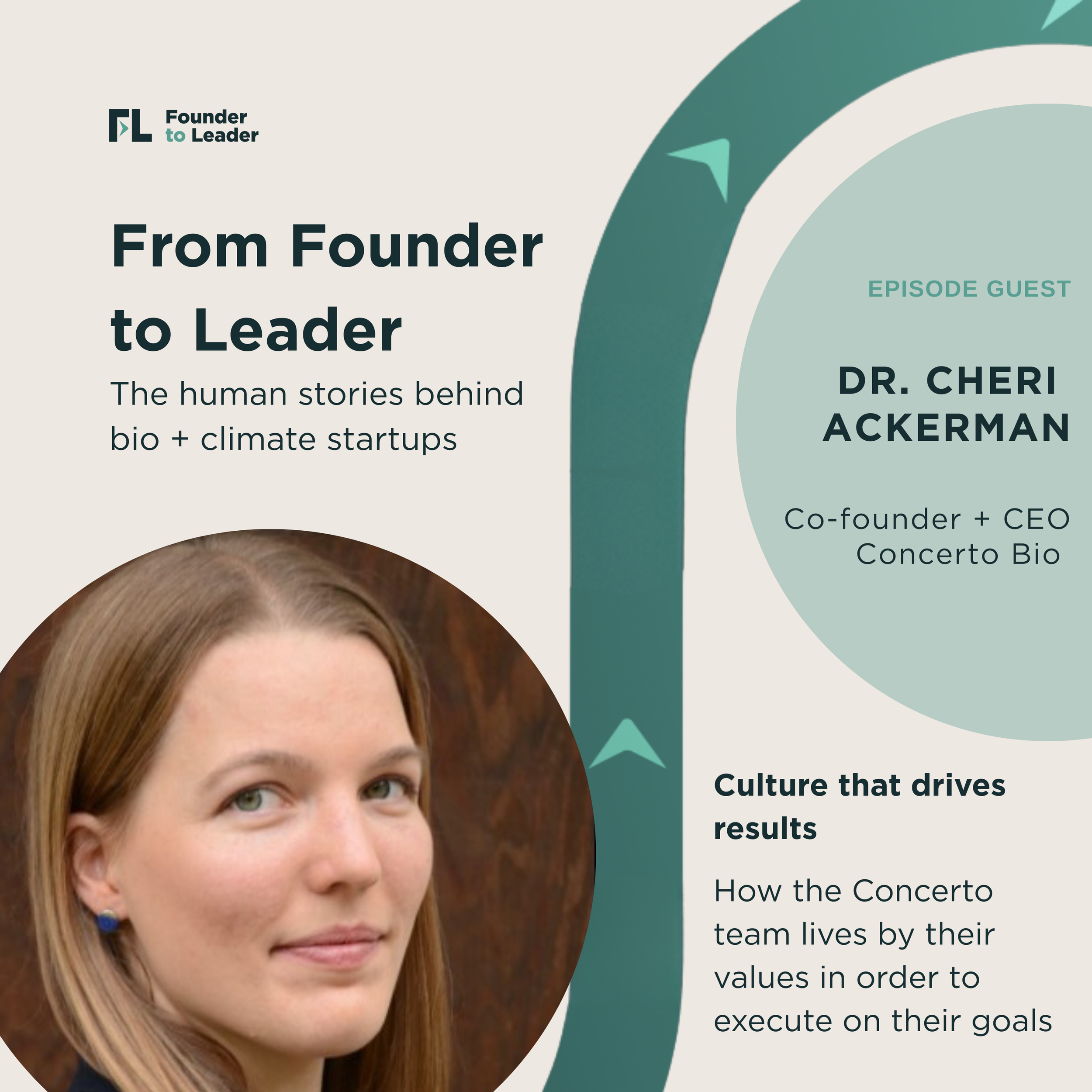
Dr. Cheri Ackerman, Co-founder + CEO, Concerto Biosciences
JAYE: Welcome to another episode of From Founder Leader, the human stories behind bio and climate tech startups. In this podcast episode, we are demystifying what it looks like to build a hard tech startup from the ground up by sharing the real human stories behind the headlines from the people driving innovation. In today’s episode, we’ll be talking with Dr. Cheri Ackerman, co-founder and CEO of Concerto Biosciences. We’re going to be talking about how culture drives results. Thank you so much for joining us, Cheri.
CHERI: Happy to.
JAYE: So tell us a little bit about you and your background and how you ended up deciding to launch Concerto.
CHERI: My background — I hail from the western side of Michigan. I did university at Calvin University, which is there. It’s a local college. And then I did a PhD at UC Berkeley. So that was a big change moving out to California. Did chemistry there and then came out to MIT to do a postdoc in biological engineering. And I worked for Paul Blaney at the Broad Institute and worked with Jared Kay and Bernardo Cervantes, who was in the Collins lab, down the hall from us. And we all got really excited about the idea that microbes should be used for influencing all kinds of aspects of human health. And we saw a pretty big gap between what microbes could be doing for human health and what they’re actually being used today to do, and how whether or not people consider microbes to be reliable. Can you actually build tools out of microbes? And it seemed like the answer was kind of we’re starting to get there. But one of the major gaps was understanding how microbial ecosystems work.
And so we had built this technology at MIT that let us understand these ecosystems. And that really helps with the translation problem, because when you’re moving a technology from the lab out into real life, it’s going to be encountering these very complex ecosystems. And if we can understand them up front, we can build products that translate better. So we started working on that concept — the technology was invented in 2016, but we started working on the company concept in 2019, ultimately spun out in 2020, and now it’s 2026, which is wild to me. So, I’m excited to talk about our journey.
JAYE: So, I teach this Management 101 class, which is now a classic part of my portfolio. And it was inspired actually by early work with your team when you were only, what, five people and starting to scale, right?
CHERI: Yes. For anyone who doesn’t know — and you can edit this out if you want to — Jaye basically wrote management 101 for Concerto, while we were also growing from five people up to around 15 or 20. Yeah. So everyone grew together and it was very helpful for us.
JAYE: And one of the things that I loved is that we talked about culture and values. And to this day when I teach management 101, I love sharing your values. And the thing that I love sharing about your values is how you consciously talk about the trade offs that come with your values. Could you talk a little bit about how you created them and why you made sure that you incorporated that into your statements and how they’ll actually play out in day to day life at Concerto.
CHERI: That question is huge. I will start.
JAYE: No. It’s good. How did you make the values the first time? Let’s start with the very tactical.
CHERI: Yeah. Our values — we have four core values. They are: Grow by experimenting, work rigorously, listen intently, and act with compassion. And when I think about the origin of our values, there are two aspects to how they came to be. One is they came to be because that is who we are, who we were as co-founders at the very beginning. So it wasn’t that we sat down one day and decided we’re going to listen intently. It was more that we already had habits of listening intently. These were things that we valued already, and so we were codifying something that was already true. And I think it can go either way. You can decide we’re going to hold a new value and change our habits. That can be a very healthy thing. For us, it was largely these are things we already value as people.
And then in terms of the actual process of how we came up with those values? Basically, the co-founding team took a retreat to New Hampshire in November of 2020, and we sat and talked. We made a giant list of all the different values that we thought could be important and whittled them down. One of our co-founders had come up with an exercise — okay, you have your top ten, knock one off, just keep making it smaller and keep making it more refined. And ultimately we got to the four that we did.
The reason that we decided to list both the positive value — what we’re choosing for — and the cost of that value — what we’re choosing against — is because of a Harvard Business Review article that we had read. So many organizations have very vanilla values like respect and integrity and diversity. And in that article they basically talked about how those are not values that help you know how to make decisions or how to run your company. Those are permission-to-play values. If you’re going to be a halfway decent company, you have to have some level of respect. How are you going to get any work done otherwise? Core values are really helpful for articulating when there are two ways of doing something, both of which could be good, and you’re going to choose one way over the other.
So just to give an example, when we talk about grow by experimenting, we are a company that is constantly growing and changing and trying new stuff. And we don’t just do that in an ad hoc way. We do that in a very systematic way. We’re going to create hypotheses about we’re going to make this specific change, and then we’re going to, over some amount of time measure what happened, because we made that change and then decide at the end of that experiment we’re going to keep this meeting structure. We’re going to change it. We’re going to keep this goal setting structure. We’re going to change it. What’s the opposite of that? What are we not if we are that thing? And some of the things you have to be willing to choose against if you’re going to grow by experimenting are things like stability and perfection. And the airline industry, for example, is not growing by experimenting — and we don’t want them to. We want them to never crash. We want them to never make mistakes. We need them to be stable and run perfectly. So being able to articulate that there are good ways to run companies that would value stability and perfection — that’s just not us. And you can go down the list of what are the things — the discomfort we choose to lean into — that we know is going to be the cost of choosing to work rigorously, listen intently, and act with compassion.
JAYE: I love that so much. And one of the things that I love as a practice that your team does is I think you really live by your values through the way that you do your quarterly and annual goal setting processes. I’m really curious for you to share with our listeners about the design of how you do that as a group, and how you try to live by your values in your process.
CHERI: Sure. So the way that we do quarterly goal setting — it’s actually annual goal setting, and then that gets broken down into quarters. We use a system called OKRs, Objectives and Key Results. If you haven’t read the book Measure What Matters, I recommend it — it is the outline for how. We didn’t invent OKRs. It’s a Google and Intel thing, I think. So we look at what we need to get done over the course of a year, over the course of a quarter, and then how do we divide that into different teams?
And the way that this came about actually was because when we first started Concerto, we would just write giant lists of everything that needed to be done and then divide up the lists, and everyone’s buckets were too full, and we would make a tiny bit of progress on a whole bunch of things, and it just felt like nothing was getting done. And everyone was mad about — you said you were going to do this and it didn’t happen. Well, it’s because I did this other thing. And there was no group consensus on what are our actual objectives for this quarter — nothing is coming between us and getting this thing done. So we started using OKRs as a way to create alignment and prioritization.
And I would say the way that our values fit into that is even when we created the OKR system, we said, it’s an experiment. We’re going to try this way of organizing ourselves. And if it works great, we’ll keep using it. And if it doesn’t work, we will identify all the ways in which it fails. And then we will choose something else. In the case of OKRs, it did work. And we just kept refining it because we felt like it was very powerful. Very much — doing OKRs forces you to listen in terms of what is everyone’s actual capacity. And we do tiered OKRs. So we’ll have the company objectives and key results. And then from that you can say okay, what is the discovery team doing. What is the manufacturing team doing. What is the data science team doing. And how do those feed up into the larger company goals? And you have to be very attentive to whether those things actually all add up.
It is a process that we run very rigorously. So every quarter it is usually a 2 to 3 week, not full-time process. But we take the time to brainstorm out what is everybody thinking about — all the different things we could try to get done this quarter — and then prioritize them. What are the things we’re choosing not to do this quarter intentionally so that we will get these other things done? And then in terms of compassion, we never want to design a set of goals that is going to crush anyone. That’s not the point, ever. So making sure that it fits with everyone’s vacation schedules and major life events and just regular old daily work-life balance — are we setting up a system in which all the people are going to thrive? Because that’s really what makes Concerto thrive over the long term.
JAYE: Back in the day — and I don’t know if you still do this — I recall pausing work entirely for a day or two to deeply, deeply align everybody on the goal setting process. Is that how you still do it?
CHERI: No, actually we don’t. So the team got too big and the dependencies got too complicated for that to really make sense. So what we do is more of a tiered approach. We start with week one — we do a set of brainstorming sessions where I am in every single session, because that is my quarterly download on what is happening across all the different teams, most of whom I would not talk with on a weekly basis or whatever. Except to talk with the leadership. But this is literally everyone from the team brainstorming across what are all the things that are going to get done. And then we take that in the second week and write the high-level OKRs. So I write the company OKRs, and then the heads of the different departments write their OKRs. And then the week after that we have the team leads write their OKRs. So we end up with — I think it’s something like 8 or 9 — different sets of OKRs. And they all talk to each other, right — they’re all in communication and add up in specific ways to each other. But yeah, we don’t actually shut down the entire company for a day. Yeah, we did used to do that.
The way that we get on the same page now is we use what we call an acknowledgments table. So a couple of things: we organize the OKRs in a way that for each key result, we call out the individual people who we think should be contributing to that key result. And if your name is called out anywhere on that list of KRs, you have to sign a thing at the bottom that says, I read this document and I understand that my name is on here. So if you disagree, let’s talk about it as opposed to getting halfway through the quarter and going, I didn’t know that I was listed on the data science OKRs doing whatever. And it’s the person who writes those OKRs — it’s their job to call out: these are the people who I think are plugging in to my team’s results, whether or not they’re on my team. And then make sure that they’ve actually read through all of those. That’s how we do alignment today.
JAYE: Taking three weeks to write the quarterly goals — how do you juggle that while also getting your work done? Because if a quarter is 12 weeks, it means you’re starting at week nine already, right? So how much time do you allocate away from still executing on the—
CHERI: Well, actually — right. So the reason that we do it that way is so that we don’t have to shut everything down for two days. I would say the major time sinks for people who are not leadership are the brainstorming meetings. And then the leadership team has very distinct tasks — it’s divided up between a group of people. So it’s just a matter of me making sure that I actually have a couple of hours once brainstorming is done and before the team needs to start to actually write those objectives. And sometimes it happens, and literally sometimes it doesn’t. Sometimes I go back to the team and I’m just — I cannot prioritize this right now. Can we talk about what it would look like for us to have a set of goals that we all agree add up? And we’re using our annual goals as a North Star, so we know we’re moving in the right direction, but we’re not going to try to articulate this on a quarterly level — a company level on a quarterly basis. And that’s okay.
JAYE: Yeah. What do you think is one of the biggest trade-offs that you’re making right now in your organization with your values, consistently over time?
CHERI: The startup reputation version of speed. So if you look at Concerto’s actual performance, we’re very fast. We brought a drug from discovery — we had in-human data in four years. Unbelievable to do all of the discovery work, all the preclinical work, all the IND-enabling work, get to clinical results. That’s nuts, right? But it doesn’t feel, when you’re in the middle of it, like sprinting. It feels very rigorous — no, we cannot start the clinical trial yet because we haven’t figured out whatever different steps that are leading into it. And yes, this does need to be reviewed by around 15 different people to make sure that we believe, because we’re about to sink X millions of dollars into this giant experiment that involves real humans.
So I think there’s some startup version of speed that says don’t worry so much about planning it out. Just try it. Just have the conversation. Just see if you can get the partnership. Whatever. We tend to be very systematic about stuff. And I think that can be — yeah, investors or people who maybe aren’t used to that style can see that as a pretty significant trade-off. But yeah, that’s just — as I said, these values didn’t happen because we made them up. They just kind of — it is who we are. And we’ve hired people who think similarly: that you go slow to go fast, do it right the first time.
JAYE: You may be one of the most deliberate teams about everything you do that I’ve ever worked with. And so that is one of the reasons why I wanted you to share with our audience, because everything you’ve done has been so thoughtful and so well, really systematically sort of designed. And I think that it is a trade-off that a lot of people say, how can I afford to spend this much time on this stuff? And it’s because we’re so deeply aligned and because we have these processes that allows us to speed up. Right.
CHERI: I love that.
JAYE: So we’re heading towards the wrap up. What one piece of advice do you have for our audience? If you have anything to share with them about leadership or anything you’ve learned on your journey, what is the one thing you wish you knew earlier?
CHERI: I don’t know why this question feels hard right now. I think the thing that I would say is something that I’m actually thinking a lot about how to get better at myself — I’ve been thinking a lot about what a network actually is. What is it? What is a network for? And how do you know if you have the right people in your network? How do you make your network not purely transactional? Because you can’t actually use a network well if it’s only transactional. On the other hand, you’re a finite person who can only have so many relationships that you maintain over such a period of time.
And so, I don’t know — the thing I’ve been thinking a lot about is strategicness, being strategic in creating a network while still being human about my network and why I invest in the particular people that I invest in. So just something to think about. I don’t have a “here’s the right way to do it,” but I think it’s incredibly important in terms of what doors will be open when. When you need the door, will the door be there? That has a lot to do with what relationships you invest in over time. And maybe it’s not something that can be engineered. I don’t know.
But I’m definitely seeing the impact. I’m six years — almost seven years — into this entrepreneurship journey at this point. And if I include the years in academia, it’s a lot of time to build up a lot of people that I know. And seeing Concerto in the middle of kind of redefining our own identity — we’ve done a lot of work in the drug space, we’re starting to think about the consumer space — who do I know that can help with that? It’s been both cool and, man, I didn’t think we were going to need people in this space. So now how are we going to get to those people, things like that.
JAYE: Yeah. Cheri, I can’t thank you enough for taking the time to share the way that you do things with our audience. There’s a lot that others have to learn about the way that you’re doing things, and I appreciate you sharing. So thank you.
CHERI: Yep. Very happy to. Good to be here.